
Most people can tell you they like floral perfumes, or that woody ones do nothing for them, without being able to say what actually separates the two. That gap is why buying fragrance so often feels like guessing: you smell five bottles, remember none of them clearly, and go home with something that turns out to be nothing like what you wanted. The vocabulary that fixes this already exists, and it is the same one the shop uses to organize its shelves: the fragrance families.
Consider this your plain-language fragrance families explained guide — the six families, what each one is built from, why the labels stick, and how to use them to find the bottle you already love without having to smell your way through the entire store.
A Note Pyramid Says When; a Family Says What
Two descriptions, two different questions. A note pyramid describes time — when you actually smell each part of a perfume, from the first bright minutes to the last quiet hours. A family describes character: the materials a composition is built from, and the impression the whole thing leaves. The pyramid tells you the order of events; the family tells you what kind of perfume you are dealing with.
Families are conventions, not laws. They are trade shorthand that makers, shops and writers all share, which is exactly what makes them useful — a word like “woody” narrows an entire wall of bottles down to a shelf. But every convention has soft edges, and by the end of this piece you will see that most perfumes refuse to sit in one family at all.
Fresh: The Daylight Family
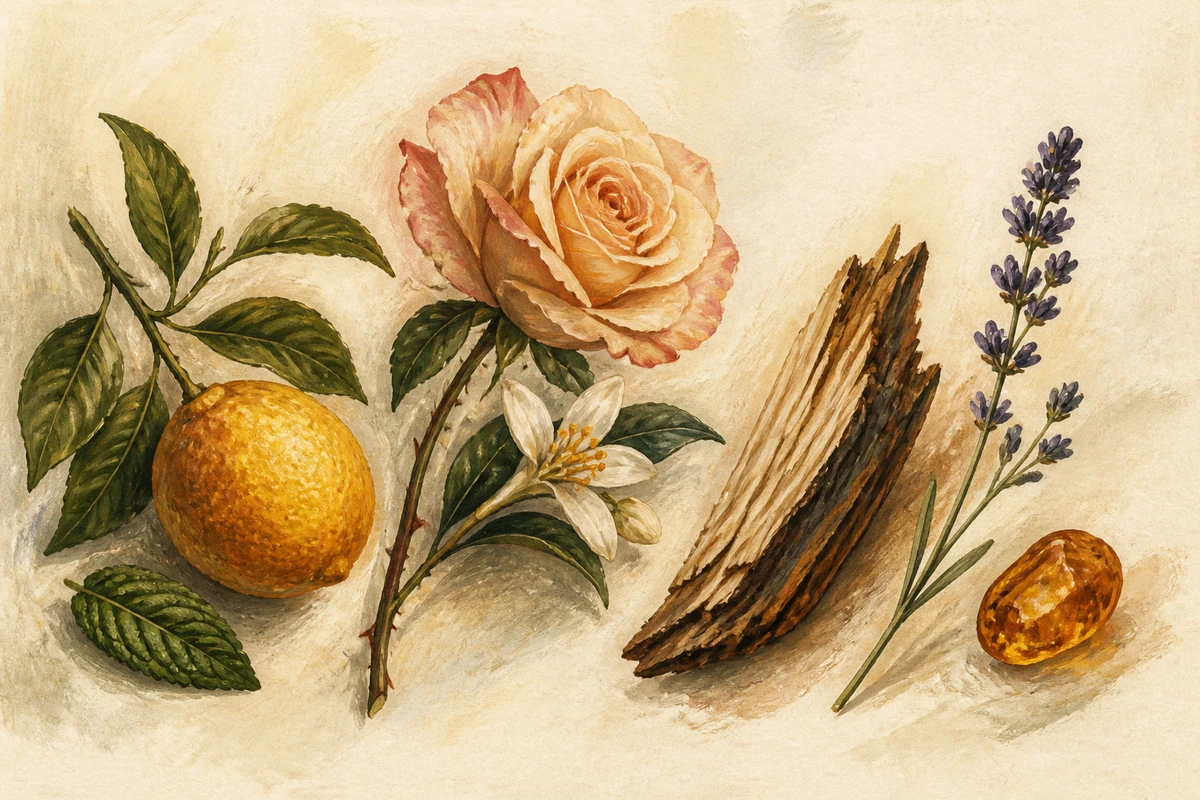
Fresh fragrances are built on citrus, aromatic herbs and green materials: bergamot and lemon, mint, cut leaves, light herbs. If a perfume feels like cool air and clean light — thin rather than dense, bright rather than warm — it belongs here. Three of the ten bottles on the site carry the tag.
Manor Tea Party is the clearest fresh bottle in the collection. It runs on herbs rather than citrus: a gentle chamomile opening, the tea-like character of yerba mate at the middle, and a soft lavender finish. Nothing in it shouts, which is the point — it is a composition built for daylight, not for an entrance.
People who like fresh fragrances usually want their scent to feel like grooming rather than perfume: clean, quiet and appropriate anywhere. Fresh is also the family most at home in shared spaces — in an office or a crowded room it reads as cleanliness rather than as fragrance, which is a quieter kind of luxury. If that sounds like you, this is your family. And if you want a hint of it without committing, note that 1957 — bergamot, coriander and a soft aldehyde shimmer at the open — is filed under fresh as well, even though the composition travels somewhere else entirely by its heart.
Tea is also a good example of a single material crossing family lines: it steadies the middle of Manor Tea Party here, and it opens Lily of the Valley No. 7 on the other side of the catalogue. We looked at what tea notes smell like in a fragrance separately.
Floral: Built Around Flowers
Floral fragrances are the broadest and easiest family to describe: the composition is built around flowers. Rose, jasmine, lily of the valley, orange blossom, iris — whichever flowers appear, they are the point rather than the garnish. Seven of the ten bottles on the site carry the tag, making it the most crowded shelf in the shop.
Hawthorn Blossom shows how a floral can move. Violet and lemon sit at the top, then jasmine, lily of the valley and green leaves at the heart, settling into iris root, musk and patchouli — with an unexpected carrot note that keeps the whole thing from turning sweet. It is a floral with a green spine, which is a useful shape to recognize.
If you are drawn to flowers but find some florals heavy or formal, look for that shape: a green or citrus edge at the open, and a quiet, powdery finish. They read as fresh-cut rather than perfumed, and they wear well in daylight. The family also spans a wide register — some florals are dewy and light, others creamy and full — but what they share is the flower at the center.
Fruity: Fruit First, Flowers Underneath
Fruity fragrances lead with fruit: peach, pear, plum, berries, grape, blackcurrant. The family almost never travels alone, because fruit notes need a floral structure to sit on — which is where the familiar label “fruity floral” comes from. When a label prints it the other way round, the floral fruity fragrance meaning is the same pair of families with the emphasis reversed: flowers first, fruit as the bright edge.
True Goddess is the site’s fullest example. Magnolia, cantaloupe, peach, pear, lemon and orange open the fragrance; evening jasmine, plum, violet and orchid fill the heart; musk, vanilla, cedar and blackberry close it. It is fruit all the way down, but the fruit never floats free — every juicy note is anchored to a flower or a wood.
If your taste runs bright, sweet and sociable, fruity is probably home. Pink Encounter is the most literal opening on the site — grape and blackcurrant over jasmine — for anyone who wants the fruit turned all the way up. And pay no attention to the idea that fruity is unsophisticated: a well-made fruity floral uses sweetness the way a kitchen uses salt — to sharpen the flavors, not to drown them.
Woody: The Skeleton Family
Woody fragrances are the family of structure: cedar, sandalwood, patchouli, musk and ambergris working as the backbone of a composition. These materials are less about smelling like a forest and more about giving a fragrance its frame — the dry, steady part that everything else is built on.
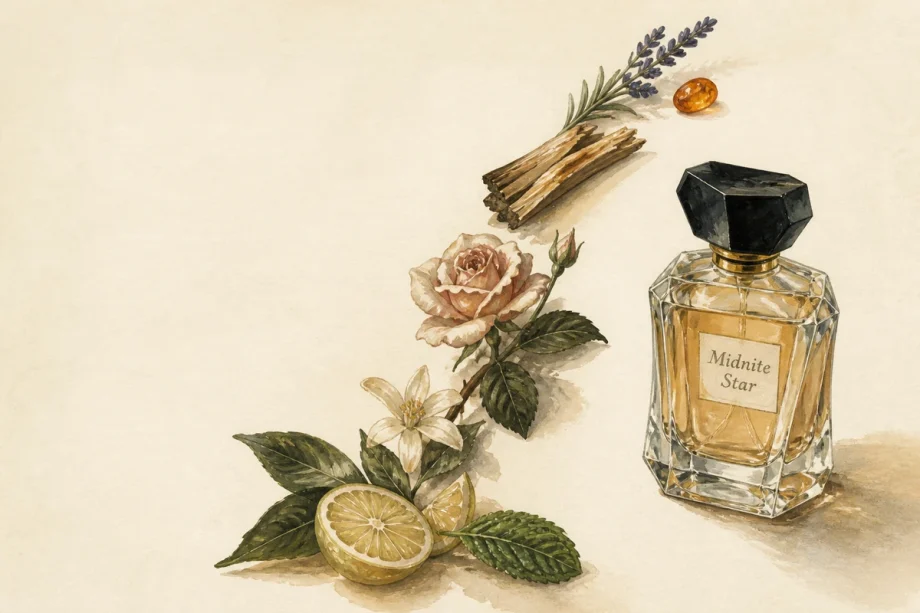
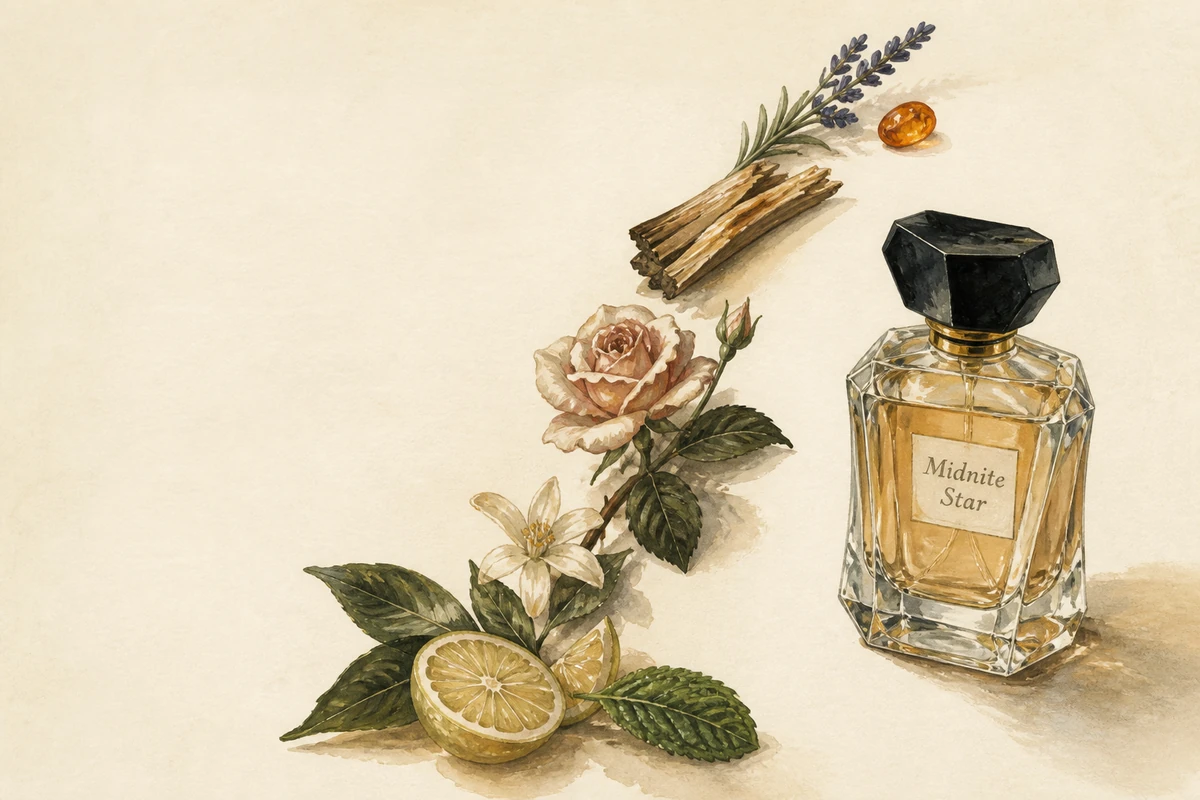
Midnight Star is the cleanest example on the site: grapefruit, lemon and mint over ginger, nutmeg and jasmine, landing on cedar, musk and sandalwood. Its bright top is arguably a fresh moment, but the family label follows the spine, and the spine is wood.
People who like woody perfumes tend to like the last hour of a fragrance more than the first — the part where the noise settles and something dry and warm remains. Because these materials are the last to leave, the woody label often describes the long second half of a perfume’s life rather than its opening. If you have ever wished a perfume would calm down sooner, you are probably a woody person.
Oriental: Warm, Dense and Resinous
Oriental and ambery fragrances are the family of resins, balsams, vanilla and warm spice — dense, enveloping and warm rather than bright. Where fresh feels like air, oriental feels like fabric: amber, incense, soft spices, a sweetness with depth rather than sugar. Three of the ten bottles carry the tag.
A word on the name, because you will increasingly see it written differently. The trade is shifting toward “ambery” for this family — a move from the old geographic word toward the material at its center. Both labels describe the same shelf, and neither is a correction of anyone’s taste.
Midnight Star sits on this shelf as well as the woody one — a spicy-woody composition whose warmth earns it a second label — and Lily of the Valley No. 7 carries an oriental thread of its own: suede, frankincense and amber resting underneath an otherwise airy floral. That is worth remembering, because it shows the family does not have to mean heavy.
Readers often arrive weighing woody vs oriental perfume — which shelf to choose. The honest answer is that the two overlap by design: woody describes the frame, oriental describes the warmth. Many perfumes you already love are probably filed in both.
Aromatic Fougère: The Most Misunderstood Label
Aromatic fougère fragrances follow the most old-fashioned structure of any family: a bright opening of citrus and lavender, resting on a base of coumarin and oakmoss. The result is that familiar clean-sharp-and-mossy profile — herbs up top, soft hay and forest floor underneath. The name comes from an early fougère composition built around an imagined fern accord; “fougère” is simply French for fern.
Four of the ten bottles on the site carry the tag, and they are not the ones most people would guess: 1957, Hawthorn Blossom, Lily of the Valley No. 7 and True Goddess all sit on this shelf. Look at that list again — a romantic floral, a tea scent and a fruit bomb, all sharing a label that sounds like it belongs in a barbershop. That is the lesson of this family: the word describes a structure, not a mood.
If you like lavender soap, cut hay, or the dry green edge of the outdoors, this family is doing more for your taste than you knew. It is also the fastest way to find an elegant, grown-up scent without moving into anything heavy.
Most Perfumes Belong to More Than One Family
The labels are shorthand, and shorthand stacks. Most perfumes worth wearing belong to two, three or four families at once, and reading those combinations is the real skill — it is how you predict whether you will like something you have never smelled.
Napoleon Eau is the site’s best example: its own product page calls it a fruity chypre with an oriental character — lemon, pink pepper, apple and blackcurrant over pineapple, jasmine and patchouli, landing on birch, ambergris, cedar, oakmoss and musk. The shop files it under four families at once: fruity, floral, woody and oriental.
Lily of the Valley No. 7 does something similar in the other direction. Its product page calls it a woody floral — thyme and tea opening, a lily of the valley heart, a suede-and-incense base — while the shelves file it under fresh, oriental and aromatic fougère. One bottle, three sections.
Then there is True Goddess, which you met in the fruity section: floral and fruity by its own description, and woody and aromatic fougère by its tags. Four labels, one perfume.
Read the first word as the dominant impression and everything after it as modifiers. “Fruity chypre with an oriental character” means fruit first, moss below, warmth running through. “Woody floral” means woods lead and flowers soften them. Once you start reading labels this way, a note list stops looking like a wall and starts reading like a set of directions.
How to Shop by Family
Here is the practical version, whether you are reading product pages or standing in front of a real shelf.
Start with a bottle you already own. Look up its family — on this site, the quickest route is to browse by fragrance family and find the shelf it sits on.

Then test within that family before wandering. Bottles on the same shelf share materials, which means your hit rate goes up dramatically — most people who believe they hate perfume have simply been sampling the wrong shelf for years.
Only then expand to neighboring families. If fresh pleases you, floral is a short step away; if woody does, try oriental. The families overlap on purpose, and the edges between them are where interesting bottles live.
Treat this perfume families guide — or any other — as a filter rather than a rulebook. Applying it before price or brand turns a wall of bottles into a shortlist of three or four: not because the label knows your taste, but because it knows the materials.
And if you would rather navigate by feeling than by materials, that is a legitimate second axis. Shopping by the feeling you want is its own way of arriving at the same answer.
What Families Do Not Tell You
One caution to carry out of all of this: a family says nothing about strength, quality or price. A soft floral can fill a room while an oriental can sit quietly against your skin, and two bottles from the same shelf can differ wildly in projection and longevity. Family is character, not volume — a description of what a perfume is made from and how it reads, never a ranking of what is better. The label tells you which shelf a bottle came from, not what it will do on your skin; for that, skin is the only test that counts.
Fragrance Families Explained: Common Questions
What is an aromatic fougère?
A family built on a lavender-and-citrus opening over a base of coumarin and oakmoss — the structure behind that familiar clean, herbal, slightly mossy profile. The name comes from an early fougère composition built around an imagined fern accord, and “fougère” is French for fern. On this site, 1957, Hawthorn Blossom, Lily of the Valley No. 7 and True Goddess all carry the tag.
Is “oriental” an outdated word?
Not wrong — shifting. The trade increasingly says “ambery,” reflecting a move from the old geographic term toward the material at the family’s center. Both words are still in use, both describe the same shelf, and you can follow whichever term the shop or writer in front of you uses.
Can a perfume belong to two families?
Yes — most belong to several. True Goddess carries four tags (floral, fruity, woody, aromatic fougère), Lily of the Valley No. 7 carries three (fresh, oriental, aromatic fougère), and Napoleon Eau carries four. Read the first term as the dominant impression and the rest as the modifiers that tell you where the composition travels.
Which family is safest for a first blind buy?
There is no universally safe family — the safest blind buy is not a family but a method. Find the family of a bottle you already wear, choose within it, and test on skin rather than paper before committing to a full bottle. Familiarity beats reputation every time.