


What does patchouli smell like in perfume? On its own, patchouli reads earthy, damp and faintly woody — closer to rich soil and dried leaves than to anything you would call perfume, with a cool, slightly medicinal edge. It is also the most divisive note a bottle can carry: some people find that earthiness settling, others find it musty, and both camps are describing the same thing.
That division is not a matter of taste so much as a matter of context, and context is something you can actually read. The Midnite Star range holds ten fragrances, and three of them list patchouli — Black Aya, Hawthorn Blossom and Napoleon Eau — spread across two positions and two very different backdrops. Between them they show both faces of the note, and learning those two faces is the whole trick. It is also, if you have ever felt outnumbered in a conversation about this note, an argument you can now make: patchouli is not one smell, and the people on the other side of the argument are not smelling what you are smelling either.
Patchouli Is Not One Smell. It Is Two Readings.
Here is the discovery that resolves most patchouli arguments: the note has a split personality, and which side you meet depends on what sits beside it. Met on its own, or next to moss, dry woods and bitter citrus, patchouli reads dark, damp and austere — the wet cellar impression that gives the note its reputation. Placed on vanilla, musk or amber, the same note turns warm, rounded and almost sweet; the dampness smooths out and what remains is a deep, comfortable weight under the composition.
This is why two patchouli fragrances can feel like two different genres. One reads like wet earth and old libraries, the other like something soft and enveloping with a shadow running through it — and both are being honest. The note did not change; the company did. If patchouli perfume meaning has always felt like a contradiction — musty in one review, cozy in the next — you are not reading confused writers. You are reading two readings.
The note also stays. Patchouli is one of the longest-lived things in a bottle: where the opening and the heart move through their phases, a patchouli finish sits down and remains, close to the skin, for most of the wear. Whatever reading you get, you get for hours — which is exactly why people form strong opinions so quickly. There is no waiting it out; there is only deciding whether you like what lingered.
It is worth understanding what the note is doing when it is used carefully, because that is how most good fragrances use it. At a low volume, patchouli is a backbone rather than a headline: it gives florals a shadow to stand in, gives fruit a floor, and keeps sweet materials from floating away. You are not meant to name it from across the room; you are meant to feel the difference it makes when it is gone. Both of the range’s base-note placements work this way — they are not bottles where patchouli is the point, but bottles where patchouli is the reason everything else holds together.
How to Tell Which Way a Patchouli Fragrance Goes
You do not need to smell a bottle to predict its direction. You need the note list, and a two-line method. First, find patchouli in the row it appears in. Second, read its neighbours. Words like vanilla, musk, tonka or amber pull it warm and rounded. Words like oakmoss, leather, dry woods or citrus keep it austere and dark. That is the entire method, and it works anywhere you can read a note list — in a shop, in a product page, or on a sample you are thinking of ordering.
It is worth applying the same reading to the whole earthy corner of the shelf, because earthy perfume notes tend to be judged as a single bloc — you like them or you do not — when in fact the family has directions within it. Patchouli is the clearest example: the same list word, two destinations, and the neighbours tell you which one you are buying. It is the whole trick to judging a patchouli note perfume before you smell it, and a reader who learns to glance at what surrounds a note has quietly learned to predict most of what a fragrance will do.
The method also works in reverse, which is where it becomes genuinely useful. If you already know you love the dry, austere reading, scan lists for oakmoss, leather and dry woods sitting near the patchouli — that is your shelf. If you know you want the soft version, look for musk, vanilla or amber in the same row. And if you are unsure which camp you are in, the method gives you a cheap experiment: order samples of one bottle from each direction rather than two from the same one, and let the two readings introduce themselves side by side.
Position Matters: Base or Heart
Where patchouli sits changes its job description. In the base, it works as a long, dark foundation — the layer the whole composition stands on, felt as depth more than as a distinct smell. In the heart, it behaves differently: it reads as a texture woven into the middle of the fragrance, adding weight and shadow to the notes around it rather than dominating from below. A base patchouli unfolds slowly and ends the story; a heart patchouli is already present when the story is halfway through, a strand running through the middle of it.
The range gives you both arrangements, which makes the point unusually concrete: Black Aya and Hawthorn Blossom place patchouli in the base, while Napoleon Eau puts it in the heart. Same note, two positions, and the difference is exactly as large as the method predicts. If you are still building the habit of reading lists top to bottom, how to read a note pyramid explains why position carries so much meaning — and why the same word in two rows can feel like two different notes.
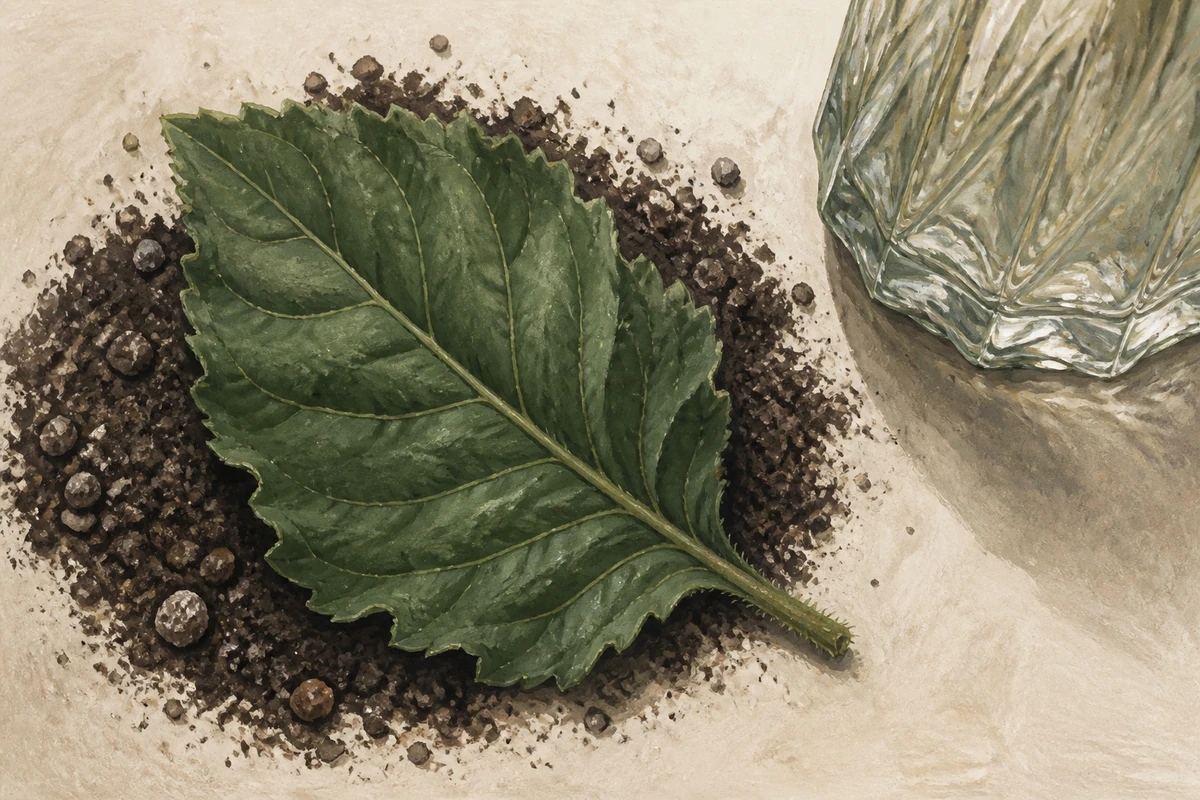
Three Patchouli Readings from the Range
Black Aya — the Warm Reading
Black Aya opens on coffee and citrus, moves through orange blossom, evening jasmine and jade, and settles onto a base of musk, vanilla and patchouli. This is the warm reading in its purest form on the site: the vanilla and musk take the dampness out of the patchouli and leave a smooth, grounded finish under the coffee — the darkest composition in the range, but dark the way velvet is dark, not the way a cellar is. If you have decided you dislike patchouli, this is the bottle that most often argues you out of it. See it on Black Aya.
Napoleon Eau — the Austere Reading
Napoleon Eau places patchouli in the heart, under a vivid opening of lemon, pink pepper, apple and blackcurrant, with pineapple and jasmine around it and a structured chypre-style base of birch, ambergris, cedar, oakmoss and musk below. Here the note is in its cool, architectural mode: the moss and dry woods keep everything unyielding, and patchouli contributes shadow and grip rather than warmth. This is the reading that explains why some people hear the word patchouli and think dark green and serious. The full composition is on Napoleon Eau.
Hawthorn Blossom — the Quiet Reading
Hawthorn Blossom is where patchouli nearly disappears. Its base — iris root, musk, patchouli and carrot — sits under violet, lemon, jasmine, lily of the valley and green leaves, and the patchouli here is doing what a foundation does: it adds weight without showing its face. Nothing about the bottle announces earth or moss; you simply notice that the flowers have more depth than flowers usually get, and that the finish stays longer than its lightness suggests. If you want to understand patchouli as a supporting note rather than a statement, this is the demonstration — on Hawthorn Blossom.
Is Patchouli Masculine or Feminine?
Neither — and the range files it both ways, which is the neatest proof available. Napoleon Eau carries the men and unisex tags while listing patchouli in its heart; Black Aya and Hawthorn Blossom sit on the women’s shelf with patchouli in their bases. The note did not change gender between those shelves; it changed neighbours. A patchouli note in perfume takes its character from the composition around it, and the shop tags describe how a store files its stock rather than who a note belongs to. If the musky warmth of the note appeals to you, musk, the note that pulls patchouli warm is the place to read about why that pairing works so well.
Why People Change Their Minds About Patchouli
Patchouli has a particular reputation as a note people come back to: dislike it once, meet it again years later, and the second meeting ends differently. The usual reason is simple — the first patchouli many people meet is a loud one, a bottle where the note is the headline rather than the foundation, and a headline is a hard place to start. The remedy is not to give up on the note but to change the introduction: try a warm reading, where musk and vanilla frame the earthiness, and let the note show you its second face before you pass judgement on its first.
There is a practical version of this advice, too. If a patchouli fragrance has put you off before, do not retry it in the same register — go deliberately to the other column of the method. Someone who found the austere reading cold should be sampling the warm one; someone who found the warm reading syrupy should be sampling the austere one. The note is wide enough that almost everyone has a patchouli they can live with — the trick is that it may not be the first one they were handed.
That is also the honest answer to why the note splits a room. A dark, austere patchouli and a warm, rounded one are both correctly called patchouli, and someone whose only encounter was with the first will reasonably believe the second cannot exist. The method in this article — position, then neighbours, then verdict — exists precisely so that you can choose your introduction rather than having it chosen for you.

What Does Patchouli Smell Like in Perfume: Common Questions
What does patchouli smell like in perfume?
Earthy, damp and faintly woody, with a cool edge on its own — and warm, rounded and almost sweet when musk, vanilla or amber are around it. Read the neighbours and you will know which of the two you are about to smell.
Why does patchouli smell musty to some people?
Because the earthy reading genuinely shares notes with the way damp places smell, and that association is immediate for some noses and pleasant for others. It is the same honesty the note shows everywhere else: patchouli does not hide what it is, and the warm reading simply gives that earthiness a softer frame. If the musty impression is what you get, try the list method in reverse — the bottles whose patchouli sits beside musk and vanilla are built to soften exactly that edge.
Is patchouli masculine or feminine?
Neither. The range carries it in men-tagged and unisex bottles and on the women’s shelf, always with a different surrounding cast. The note follows its composition, not a gender — how the fragrance families differ is a useful next read if you want the wider map.
How do I tell a warm patchouli from an earthy one before buying?
Read the note list: vanilla, musk, tonka and amber signal the warm reading; oakmoss, leather, dry woods and citrus signal the austere one. A bottle that lists patchouli with neither column of words is the unpredictable middle — sample it on skin rather than guessing. For the two directions side by side on this site, the darker, addictive side of the shelf collects Black Aya’s register, while browse the oriental family shows where the deep, warm structures live — and between those two pages you will have seen almost everything patchouli can do. Start with the list, trust the neighbours, and the note will tell you exactly which version of itself it plans to be.