
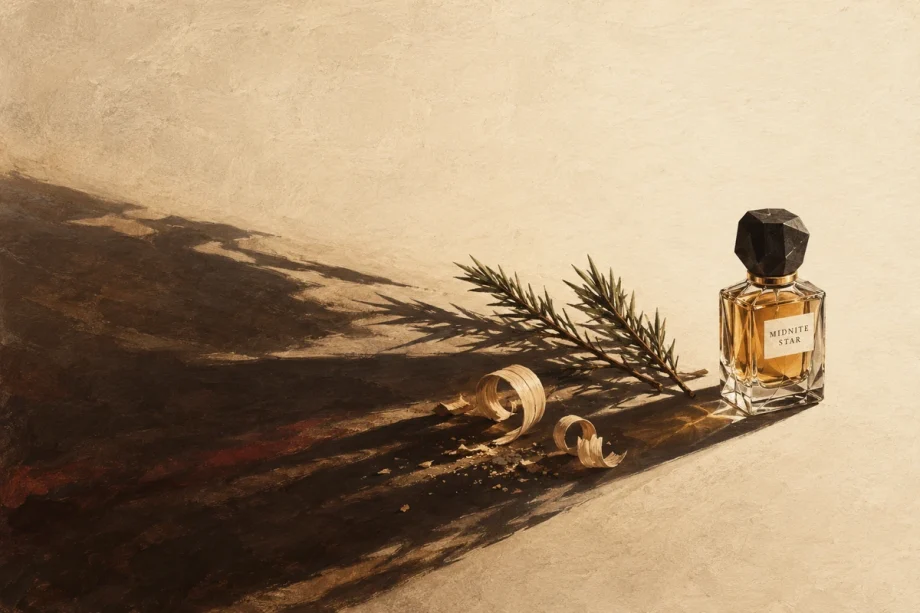
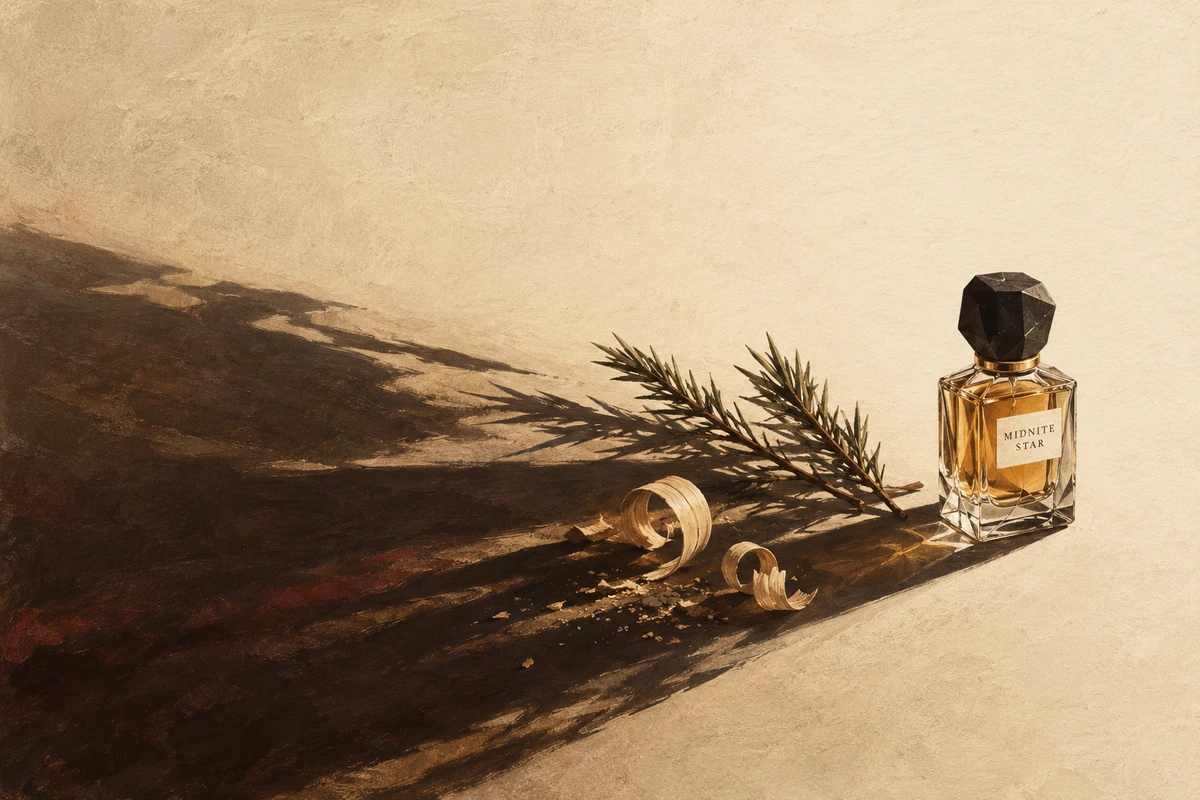
What does cedar smell like in perfume? At its most basic, cedar reads dry, clean and faintly sharp — closer to pencil shavings than to a warm log, and noticeably cooler in tone than most wood notes you have met. It is the note that keeps a base honest: where a formula wants to drift toward cream and sweetness, cedar holds it in place. Think of the cool, clean smell of a lumber yard after rain rather than a fireplace at night, and you are most of the way there.
That role is easy to miss until you look at how often it quietly does the work. The Midnite Star range holds ten fragrances, and five of them list cedar in the base — Midnight Star, Pink Encounter, 1957, Napoleon Eau and True Goddess. In every one of those bottles cedar is not the star of the finish; it is the edge that stops the finish from turning soft. This guide is about reading that edge — what dry means on a note list, how cedar behaves beside the other materials, and why the same base can feel alert in one bottle and blanket-like in another.
What Dry Actually Means on a Note List
Here is the discovery that makes cedar click: dry does not mean faint, and it does not mean absent. A dry note is not a quiet note — it is a note without sweetness and without cream. That single distinction explains a whole family of impressions. Two fragrances can share the same woody skeleton and feel like different seasons of the same personality: one structured and slightly cool, the other rounded, plush and warm. The difference is usually not the wood you can name. It is whether a dry wood like cedar was included to pull the base taut.
When it is, the base reads with structure — closer to a well-made chair than a sofa. When it is missing or replaced by something creamier, the same skeleton can collapse into softness, and the fragrance reads heavier than its materials list deserves. That is the real answer to why some woody scents feel alert while others feel like a blanket, and it is the reason cedar deserves its own reading rather than a line in a glossary. If cedar perfume meaning has always felt vague to you, hold onto one phrase: the absence of sweet and creamy, made deliberate.
A quick test makes the idea concrete. Imagine two fragrances with identical note lists except for one clause: cedar. In the first, the wood stays as written, and the base holds its line from the first hour to the last. In the second, replace the cedar with something creamier and watch the whole composition shift — the same fruit up top now reads sweeter, the same musk reads plusher, and the fragrance feels fuller but less defined. Nothing else changed. That is the leverage a single dry material holds over an entire composition, and it is why cedar turns up in bases belonging to families that have nothing else in common.

Cedar vs Sandalwood, Briefly
Cedar and sandalwood are the two woods people most often confuse, and the practical distinction fits in a sentence: sandalwood is creamy and soft, cedar is dry and angular. Sandalwood rounds a base off; cedar keeps a base in line. If you want the other side of that comparison in full — why sandalwood reads smooth and where it sits in the range — I wrote the long version in sandalwood, the softer wood, and it is the natural next read after this one. For now, three sentences are enough: when you smell a base and think of warm milk or polished furniture, you are in sandalwood territory; when you think of pencils, sawdust or a brisk clean air, you are in cedar territory; and a surprising number of good bases put the two side by side so that each reads more clearly.
How to Spot Cedar on a Note List
Two signals do most of the work. First, position: cedar almost always sits in the base. It is a note that arrives after the opening has burned off and stays for the part of the wear you will actually live in. Second, company: note lists rarely let cedar stand alone. It appears beside questions of texture — musk, oakmoss, or a catch-all phrase like woody notes — because cedar is a shaping note more than a leading one. Spotting these wood notes working in a texture section is easier once you know how the layers are drawn; how to read a note pyramid is the ten-minute version.
The telling detail is what cedar does not do. It rarely announces itself. In most compositions cedar is the note making another note behave — taming a fruit that wants to become syrup, keeping a honeyed heart from drifting toward dessert, giving a mossy base its spine. Where woody perfume notes are concerned, cedar is frequently the staff rather than the voice, and once you know to look for it you will find it written into more bases than you expect. A reader who learns this one habit — checking the base row for a dry wood — has effectively learned to predict how heavy a fragrance will sit before ever smelling it.
One more reading skill worth adding: notice what cedar is next to. Beside musk it reads polished and quiet, the musk blunting its corners while the cedar returns the favor by keeping the musk from going flat. Beside oakmoss, as in a chypre-style base, it reads more rugged and shadowed, and the pair is a large part of why that structure feels old-world rather than soft. Beside vanilla or honey it becomes a tension line — sweet above, dry below, the two holding each other in place. Same note, three completely different jobs, and the note list tells you which one you are buying.
Four Cedar Bases, Four Readings
The range gives four worked examples of what cedar does when it is placed differently. All four carry cedar in the base; what changes is the company it keeps, and with it the way the dryness reads.
Midnight Star
Midnight Star lists its base as cedar, musk and sandalwood beneath a bright opening of grapefruit, lemon and mint and a spiced heart of ginger, nutmeg and jasmine. This is the driest daily wear in the range: the citrus and mint set a brisk tone at the top, and the cedar-musk-sandalwood finish answers in the same key rather than softening it. The result reads composed and slightly cool — the woody side of the collection at its most practical. You can see the full composition on Midnight Star.
Pink Encounter
Pink Encounter is the softest cedar reading here, and the most instructive. Its base — white musk and vanilla cedar — sits beneath grape and blackcurrant at the top and jasmine and Rose Taif Flower in the middle. Cedar this far forward in sweetness is not there to be noticed; it is there to stop the fruit from going syrupy and to give the finish a floor. The bottle reads as a fruit scent first and a musky woods second, which is exactly the effect a dry wood can produce when it is used with restraint. It is also the most accessible entry point to the whole idea on Pink Encounter. The trick is worth naming: cedar here is an anchor for sweetness, and it works precisely because it is outnumbered. Add more of it and the fruit would go austere; remove it and the finish would collapse into syrup.
1957
1957 places its cedar beside Kashmir wood, vanilla, honey, musk and iris root — as soft a base as the range builds, with pink pepper, coriander, bergamot, aldehyde and musk opening above and orange blossom and jasmine in the middle. Here cedar is the dry edge inside a soft fragrance: the honey and vanilla want to pull the finish toward cream, and the cedar keeps just enough tension in the line. Wear it and you feel both things at once, which is the most useful lesson of the four — dry is not the opposite of soft, it is what stops soft from becoming shapeless. The same principle is why honeyed fragrances so often hide a dry wood in the final row: it is the quiet guardian of their softness. The full note list is on 1957.
Napoleon Eau
Napoleon Eau gives cedar its busiest setting. The base runs birch, ambergris, cedar, oakmoss and musk — a mossy, structured finish under lemon, pink pepper, apple and blackcurrant up top and pineapple, jasmine and patchouli in the middle. In this company cedar is one voice in a bigger structure rather than a soloist: the oakmoss and birch set the tone, and cedar keeps the whole assembly from settling into heaviness. It reads as the most complex of the four, and the one where cedar is easiest to overlook and hardest to remove — take it out and the base would lose its edge. The composition is on Napoleon Eau.
A fifth bottle, True Goddess, also lists cedar — alongside musk, vanilla and blackberry — so the count across the range stands at five cedar bases out of ten. If you want to look at the family these bottles share, browse the woody family and you will find the same dry current running through all of them.

Three Things a Cedar Base Changes in Practice
First, proximity. Cedar bases tend to sit closer to the skin than sweet, resinous finishes do — they read as something worn rather than something announced. If your complaint about fragrances is that they feel loud, a cedar base is often the fix. Second, temperature. A dry finish reads cooler in character, which is why woody scents built this way tend to come into their own as the air cools and heated rooms make sweeter finishes feel too much. Third, timing: a cedar-forward scent can feel sharp for the first half hour, then settle into something steadier as the base takes over from the opening. None of these are flaws — they are the texture of the note, and knowing to expect them is most of the adjustment.
Who Should Look for Cedar
If warm woody scents have always felt too heavy, too sweet or too much like a dessert, cedar is the note to hunt for in the base row: it is the standard correction, and dry woody perfume built on it will feel lighter on the skin while keeping the woody character intact. If the opposite is true — if dry scents have always struck you as austere — then sandalwood is the better target, and the sandalwood piece explains what to look for.
It is worth saying that cedar is not a men’s note or a women’s note, whatever the shelf labels suggest. Three of the four bottles above carry both men and unisex tags, True Goddess is filed under women, and the same dry wood runs through all of them — the composition decides how cedar will read, not the wearer. If you want to see how the range itself organizes these bottles, the men’s selection and its counterparts give you the shop’s filing, and how the fragrance families differ gives you the map behind it.
What Does Cedar Smell Like in Perfume: Common Questions
What does cedar smell like in perfume?
Dry, clean and slightly sharp — pencil shavings rather than a warm log, with a slightly cool tone. In a base it most often reads as structure: the note that keeps other materials from sagging into sweetness. You rarely smell cedar alone, and that is by design. The impression it leaves is of cleanliness with a grain to it — smooth enough to wear, textured enough to notice. If you have ever called a fragrance crisp without being able to say why, cedar was probably the reason.
Is cedar masculine or feminine?
Neither. The range plants cedar in bottles filed under men, under women, and under both, and the note reads the same in all of them — like a shade of wood in furniture, it takes its character from its surroundings. Shelf labels describe how a shop files its stock, not who the note is for.
What is the difference between cedar and sandalwood?
Sandalwood is creamy, soft and rounded; cedar is dry, angular and slightly cool. Sandalwood makes a base feel plush; cedar makes it feel taut. Many well-built bases use both, letting the cedar supply the edge and the sandalwood supply the comfort. A useful rule of thumb: if you want the base to feel like furniture, sandalwood; if you want it to feel like the workshop where the furniture was made, cedar.
Why does cedar feel sharp at first?
Because the opening of a fragrance is always the brightest, quickest-reading part, and cedar arrives underneath it, where the dry edge is felt before it is understood. Give a cedar scent half an hour on skin and the sharpness resolves into something smoother and more grounded — the note has not changed, only the part of it you can hear.