
Perfume note pyramids are sold on every product page as if they were a rating. They are not. A perfume note pyramid is a timeline: it tells you the order in which materials appear and leave, from the first minutes on skin to whatever is still there at night. The top of the pyramid is simply what evaporates fastest; the base is what stays. Once you can read the structure, a note list stops looking like a wall of ingredients and starts reading like a sequence of events.
That reframing changes how you shop. Instead of asking whether you like grapefruit, you can ask whether you like grapefruit for ten minutes, bergamot and jasmine for the next few hours, and cedar and musk for the rest of the day. Most buying mistakes come from liking one part of the sequence and buying the whole bottle anyway. It is also the best first lesson in fragrance notes for beginners, because it organizes everything else on the page. Here is how to read a fragrance pyramid properly, layer by layer.
Top Notes: The First Twenty Minutes
Top notes are the opening act: the smell of the first spray, and generally of the first minutes that follow, fading within roughly the first half hour. They are built from the lightest, most volatile materials in the formula, which is why they leave first, and the alcohol that carries them off the skin takes part of the impression with it. None of this is a fault. It is the physics of the materials doing exactly what they were chosen to do.
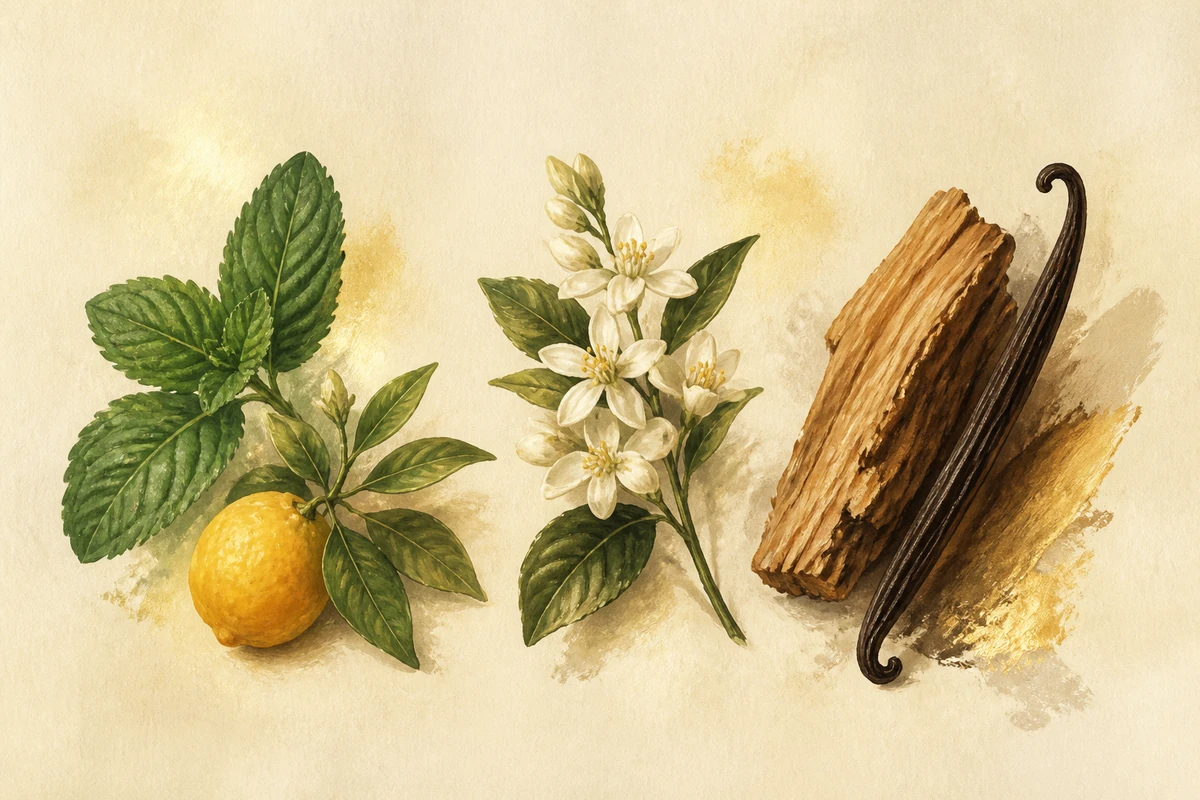
Citrus and aromatic materials dominate this tier: grapefruit, lemon, bergamot, mint. They give the composition lift and air, and they are also the easiest part to fall in love with by accident. A citrus top is not automatically cheap or simple; it is simply first. A top note can even be counter-intuitive: Black Aya opens on coffee and citrus, a case of coffee sitting in the opening rather than the base, which is worth knowing before you assume that the note you love at first spray will still be there at dinner.
The practical rule follows from the timeline: do not judge a bottle on the first spray. The opening is the fastest, brightest part of the fragrance’s life, and everything that follows is still on its way.
One habit makes the top layer much easier to judge. When you test a fragrance, note what you smell at one minute and again after half an hour. The difference between those two readings is not noise; it is the top handing over to the heart, and learning to feel that handover is most of what reading a pyramid trains.

Heart Notes: The Character of the Fragrance
The heart is where a fragrance stops announcing itself and starts being itself. These notes sit behind the opening and carry the next few hours: florals, spice, and green materials are the usual residents. The heart is also, for most of the working day, what the people around you actually smell — the top has usually burned off by the time you are across a meeting room, and the base is still quietly gathering strength.
Florals are this layer’s home ground, and if you want to tour the family in one place, the floral fragrances shelf gathers most of it. Spice brings the heart warmth — ginger, nutmeg, pink pepper, coriander — and greens keep it honest: the freshly cut-stem character of Hawthorn Blossom comes from a heart of jasmine, lily of the valley and green leaves, sitting between a violet-and-lemon opening and a base of iris root, musk and patchouli.
If you are new to reading fragrance notes, learn this middle layer first. It is the longest-lasting part of what most people casually call “the smell of the perfume”, and the two hours it occupies are the ones you will spend in public.
On a product page, a heart-heavy fragrance is easy to spot: the middle row is the longest or the most specific, because that is where the perfumer wants you to live. When the heart is thin and the base is long, the reverse is true; the composition is built for its second half.
Base Notes: What You Live With
Base notes are the materials that outlast everything else. Woods, musks, resins, vanilla and patchouli live here, and they surface gradually: what is still detectable on skin from mid-afternoon into the evening is the base, doing the slow work. When people describe a fragrance’s warmth, its depth, or the way it “sits close”, they are almost always describing this layer.
What are base notes in perfume, plainly? The foundation. They are the heaviest, least volatile materials in the formula, and they are also the layer your skin negotiates with. Two people carrying the same fragrance can agree completely on its opening and disagree about its final hours, because the base is where individual skin chemistry has the most time to speak. If you are choosing between two bottles you like equally on first spray, the base is the tiebreaker — it is the part you will actually wear.
Resins and amber are worth watching for. They do not announce themselves the way woods do; they smooth the edges around everything else and make a base feel rounded rather than dry. If a base lists amber or frankincense next to musk and woods, expect the final hours to feel quieter than the middle of the day.
Why the Same Note Reads Differently
A note name is a starting point, not a guarantee, because the same material behaves differently in every setting it visits.
Paper and skin are different instruments. On a blotter, a pyramid reads in order and at even volume; on skin, moisture and body heat take over. Dry skin is widely described as releasing a fragrance faster, moisturised skin as holding it longer, and warmth as lifting everything sooner — which is why the same scent can last an afternoon on one wrist and a morning on another. Base notes on skin can also take half an hour to fully surface, so the moment a fragrance suddenly makes sense is often a surprise much later than you expected. Climate moves the clock too: warm, humid air lifts materials faster, and cool dry air slows the arc down, which is why the same bottle can read differently in September and February.
The company a note keeps matters as much as the note itself. Bergamot in a bright citrus is not bergamot sitting at the top of a mossy chypre, and “tea” can mean leafy, floral or creamy depending on what surrounds it — an argument we made at length in what tea smells like in a fragrance. And timelines move with concentration: an eau de toilette and an eau de parfum are built to different clocks. How concentration affects what you smell is worth one read before comparing any two pyramids side by side. In this collection, almost everything is an eau de parfum; the exception is Lily of the Valley No. 7, an eau de toilette, which should be read on a lighter, quicker clock than the nine bottles around it.
Reading a pyramid well also means reading it comparatively. Two bottles can share a top note and part ways immediately after; the interesting question is never whether a material is present, but what it is doing there and what it is doing it with.
Three Perfume Note Pyramids, Read Layer by Layer
Time to read real examples. Each is laid out the same way on the page, top, heart and base notes explained in order; what changes from bottle to bottle is where the weight sits.
Midnight Star: The Clean Three-Tier Structure
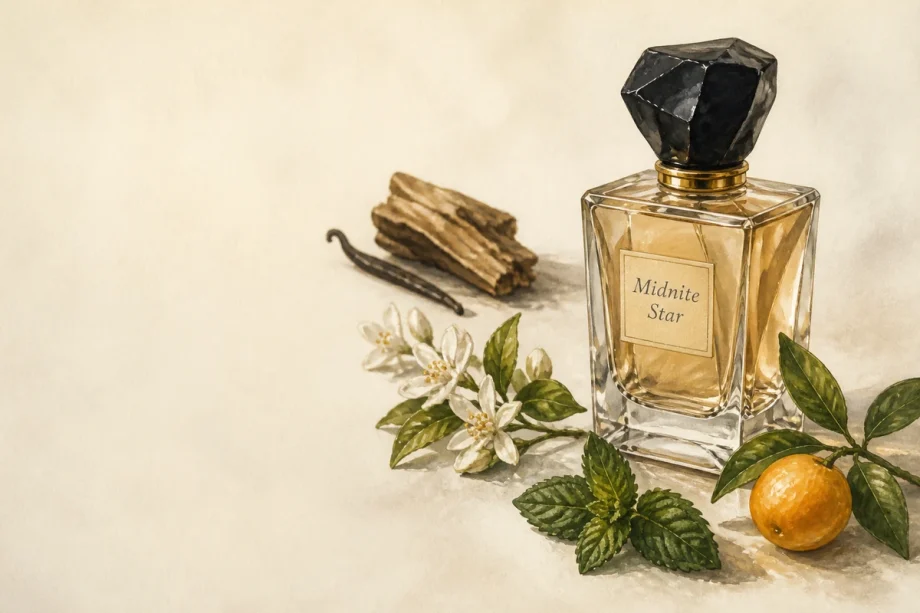
Midnight Star is the easiest pyramid in the collection to follow. The top is a bright trio — grapefruit, lemon and mint — arriving cool and almost sparkling, and settling within the first half hour. The heart turns warmer: ginger, nutmeg and jasmine, spiced and softly floral, holding the middle of the day. The base is cedar, musk and sandalwood, dry and smooth, staying close to the skin into the evening. The movement runs in one direction only — bright to quiet, cold to warm — which makes it a good first pyramid to practice on. If you like the middle either side of it, you can trust this bottle before you smell it. The base is also where it settles into something quiet and wearable, which is why it survives a working day better than its cool opening suggests.
Manor Tea Party: The Beginner’s Pyramid
Manor Tea Party compresses the lesson into three single notes, which makes it the clearest teaching example here. The top is chamomile: soft, herbal, gently floral, and gone relatively quickly. The heart is yerba mate, and for the couple of hours after the opening, that tea character is the fragrance. The base is lavender, arriving late and staying. On skin, the distance between minute ten and hour two is unusually visible — the pyramid is not a formality in this one, it is the whole show. As a first lesson it is close to a textbook example: one material per tier, nothing hidden.
1957: Where Most of the Fragrance Sits
1957 teaches the opposite lesson: sometimes the base is the point. The top — pink pepper, coriander, bergamot, a soft aldehyde shimmer and musk — is quick and sparkling, handing over early. The heart is a white-floral pair, orange blossom and jasmine, over that thread of musk. Then comes the long part: vanilla, honey, musk, cedar, Kashmir wood and iris root. Six of the listed materials live in the base, which is why 1957 keeps unfolding for hours while its opening is a memory by lunchtime. If the materials you love always seem to be the ones at the end of a description, look for this pyramid shape. It also shows why a family label like “floral fruity” only covers the first act: by the time the base is fully open, the fruit is long gone and the finish is powdery, warm and close.
Using a Perfume Note Pyramid Before You Buy
Read the base first. It is the part you will wear for the longest stretch, so it deserves the first vote — if the base contains materials you dislike, the beautiful opening should not outvote them.
Then check the heart against what you already wear. If the middle layer overlaps a family that keeps reappearing in your collection, the odds improve dramatically; if it is entirely new territory, treat the pyramid as a preview of a country you have not visited. If you would rather navigate by territory than by bottle, browse by olfactory family is the map.
Treat the top as the first twenty minutes only. Enjoy it, but do not buy for it.
A pyramid is also a filter, and filters are what you need on a long shelf. Reading three rows takes a minute and rules out most of the store before you spend an afternoon sampling: if the base contains materials you dislike, nothing in the opening will save it; if the heart matches a family you already love, the rest is worth your time.
Finally, know the pyramid’s honest limits. It tells you sequence, not intensity, not sweetness, and not projection — a quiet scent and a loud one can share the same three-tier shape. It also cannot tell you how the arc will run on your skin, which is the one variable only wearing it can settle. That is what samples are for, and buying a scent you have never smelled covers the habits that make them work.
Questions About Note Pyramids
Why do top notes disappear so fast?
Because they are built from the lightest, most volatile materials, and because the alcohol that carries them off the skin leaves at the same speed. The opening is designed to be transient; its job is the first impression, not the memory. It is also why a first spray in a shop is a poor test: you are smelling the one part of the fragrance that will not be there by the time you get home.
Do more notes mean a better perfume?
No. A note list is a sketch, not a score. Some compositions list five materials, some list twenty, and the number says nothing about balance, quality or how the fragrance will feel on skin. Judge the balance between the layers, not the number of entries.
Do note pyramids tell you how strong a fragrance is?
No. They describe sequence, not intensity. Strength lives in concentration and materials, which is why two bottles with similar pyramids can sit on opposite ends of the shelf when it comes to presence. If volume is what you are shopping for, the pyramid will not tell you; wearing it will.
Why do two perfumes with the same notes smell different?
Because notes are impressions, not recipes. The proportions and the surrounding materials decide the result, so a rose, vanilla and sandalwood list can produce anything from a powdery romance to a dark resin. Read the whole pyramid, not the headline note. And when the pyramid runs out, skin becomes the last page.