
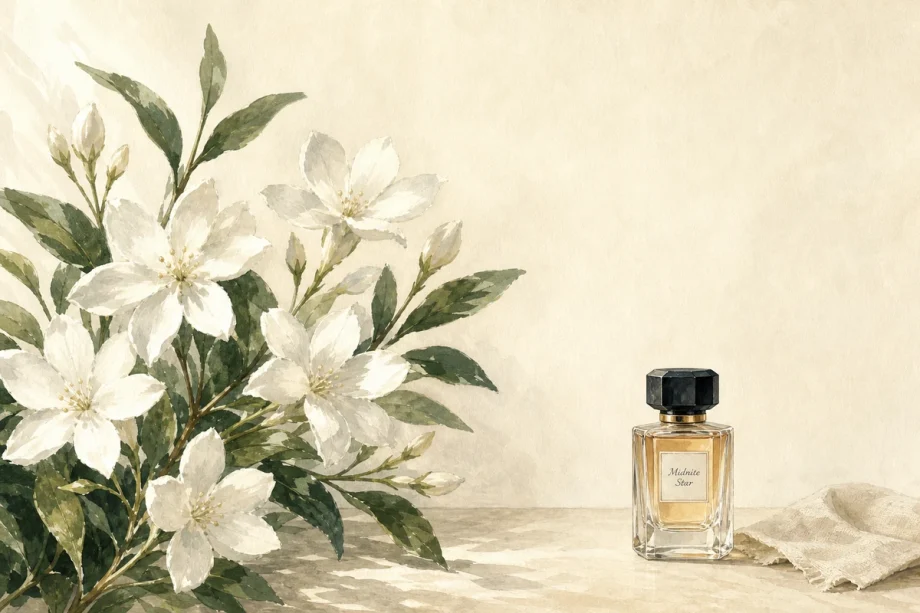
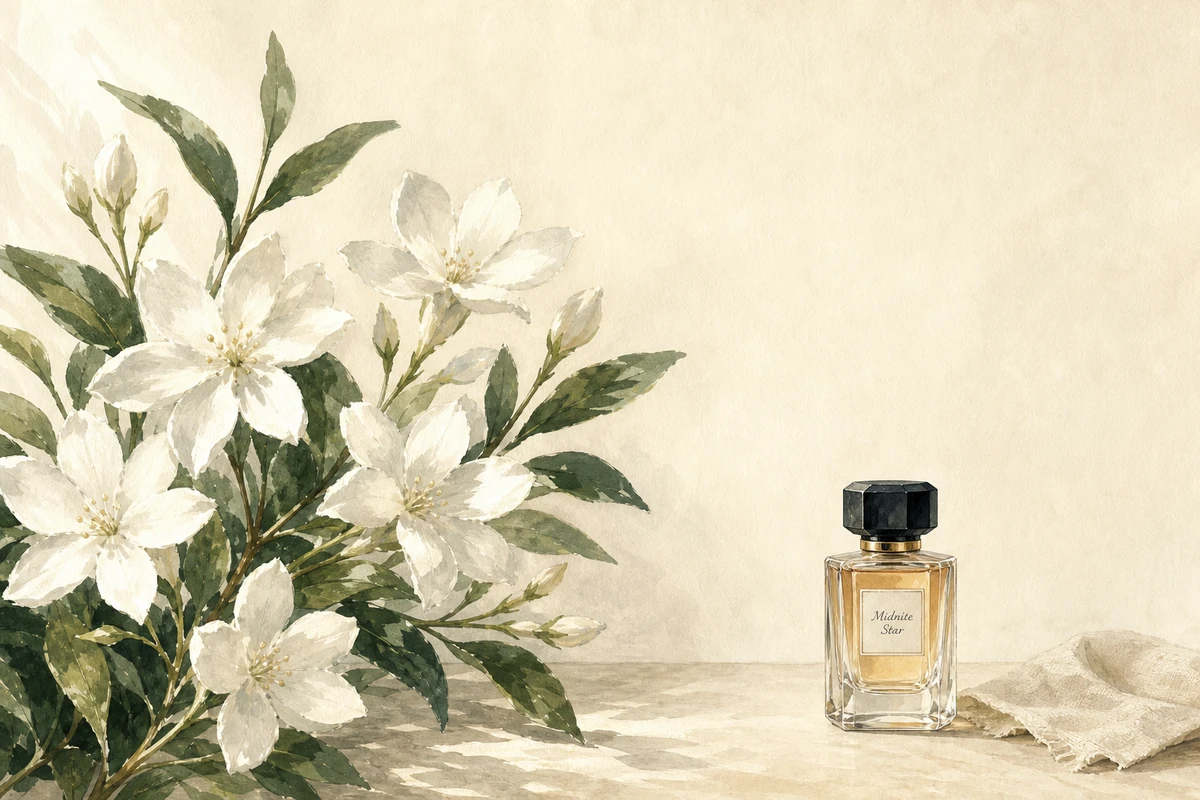
What does jasmine smell like in perfume? Two answers, both correct: heady, creamy and slightly sweet — or clean, soft and soapy. The same flower produces both, and which one you meet depends almost entirely on what sits around it. Jasmine is less a fixed scent than a character actor: it takes the role the composition hands it, and this range gives it more roles than any other note.
That is not a coincidence of taste. This collection leans on jasmine harder than on almost anything else, and where it puts the flower tells you something real about how the house builds fragrances. This guide unpacks that — the finding first, then the two readings, then how to read jasmine on a note list before you buy. By the end, a word that used to mean one thing on a label will mean half a dozen things, all of them accurate.
The Collection’s Middle Note
Here is the discovery that makes jasmine unusual in this range: jasmine appears in the heart of seven of the ten bottles, and never once in a top or a base. Seven compositions place it in the middle; zero place it at the beginning or the end. The three bottles that skip it entirely — Enchanted Fox, Manor Tea Party and Lily of the Valley No. 7 (the range’s only eau de toilette) — leave the flower out completely, which makes the pattern even clearer.
So what does a heart placement mean in plain terms? The heart is what you smell once the sharp opening has burned off — the stage where a fragrance stops performing and starts living on skin. A note parked there is not the first impression; it is the body of the fragrance. Put jasmine in the heart seven times and you have a house signature: flowers that arrive quietly after the sparkle, and stay for the part of the wear people describe as “the actual smell”.
Why would a house treat its most-used flower this way? Because the middle is where a composition stops shouting and starts being worn. A jasmine in the opening would dominate every first impression the range makes; a jasmine in the heart becomes the thing you live with — the quiet constant under spice, fruit, coffee and woods alike. Placement is not a demotion here. It is the difference between a flower that announces and a flower that belongs.
For readers new to this structure, how to read a note pyramid walks through why placement matters as much as the ingredient itself. The short version: where a note sits tells you when you will live with it.
Why the Same Flower Reads Two Ways
Ask two people to describe the same jasmine fragrance and you may get “rich and velvety” and “clean and bright” in the same conversation. Both are describing the flower accurately — it simply amplifies its surroundings. A jasmine surrounded by fruit reads softer and rounder, the fruit smoothing its edges. One sitting under spice, or beside green leaves, reads cooler and sharper, the flower’s brightness pushed forward. One resting over a warm base — amber, musk, vanilla territory — reads heavier and creamier, the warmth pulling it toward velvet.
Keep the mechanism at that level, because that is honestly all a note list gives you: context. There is no need to reach for anything more exotic to explain what your nose is doing. That, in one line, is the jasmine perfume meaning most readers are hunting for: the flower is a constant, and the reading is negotiated with its neighbours. Think of it as a good actor rather than a fixed costume: give it fruit and it plays soft, give it spice and it plays sharp, give it warmth and it plays velvet — and it is never miscast, only directed.
This also explains why jasmine has a reputation as a “difficult” note. People meet one loud, heady jasmine, decide that is what the flower is, and avoid it forever — never meeting the soft, clean versions that would have suited them. The flower did not change. The company did. The same jasmine can be a whisper in one bottle and velvet in another without either reading being wrong; that is not inconsistency, it is the note doing its actual job.
Evening Jasmine: Reading the Wording on a Label
Two bottles in this range — Black Aya and True Goddess — list “evening jasmine” instead of plain jasmine, and that wording is worth understanding exactly for what it is: a signal about the reading. On a label, an evening jasmine note is the heavier, darker casting of the flower — the version that lands closer to velvet than to soap.
What it is not is a botanical fact. Nothing on a note list tells you that one flower and another are different plants; the wording is editorial intent, and treating “evening jasmine” as a hint about mood is the honest way to read it. Treat the word as a stage direction, not as a claim about the flower itself.
Reading Jasmine by Its Neighbours
The most practical skill in this article: predict a jasmine’s character from whatever is printed beside it. The collection offers six worked examples.
Fruity. Pink Encounter puts grape and blackcurrant in front, then jasmine and Rose Taif Flower — the softest reading in the range, fruit taking the lead while the flower follows. True Goddess is the grand version: a long fruit opening (magnolia, cantaloupe, peach, pear, lemon, orange) resolving into a heart where jasmine is listed twice — the fullest jasmine reading on site.
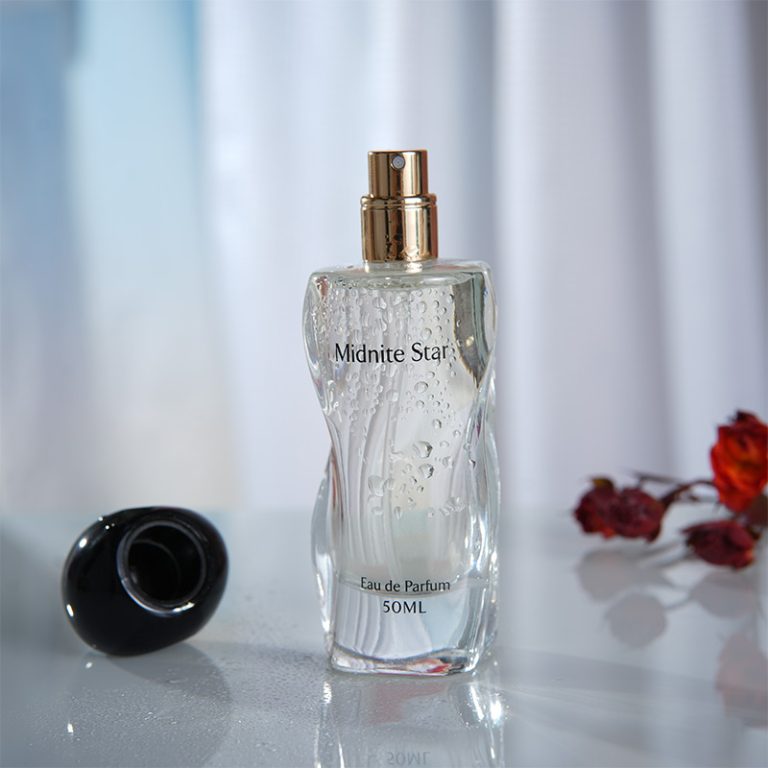
Spiced. Midnight Star sets jasmine under ginger and nutmeg, so the flower arrives warmed and slightly sharpened — spice does to jasmine what it does to food.
Green. Hawthorn Blossom places jasmine beside lily of the valley and green leaves: the coolest, cleanest reading here, closer to a garden after rain than to an evening perfume.
Dark. Black Aya sends coffee and citrus ahead of its jasmine, with musk, vanilla and patchouli underneath — the heaviest casting of the flower in the range, and the one that shows how far a white floral can travel from its soapy stereotype.
Structured. Napoleon Eau drops jasmine into the middle of a busy, moody construction built on what a chypre base is built from — the flower working as architecture rather than decoration, holding its place between pineapple, patchouli and the mossy foundation below.
Read in that order, the six bottles form a short course in note literacy: the flower never changes, and everything around it does.
If you want the map these six sit on, how the fragrance families differ shows how a floral note crosses into woody and oriental territory depending on its company.
Is Jasmine Feminine?
No — and the range’s own paperwork is the evidence. Three of the seven jasmine bottles — 1957, Midnight Star and Napoleon Eau — carry the men’s and unisex tags, which means the flower is filed across every shelf the house keeps. What changes between those bottles is never the jasmine; it is the base under it: musk and honey in 1957, cedar and sandalwood in Midnight Star, oakmoss and ambergris in Napoleon. If you want to see the note used without any gender story attached, the men’s selection is where the house itself files it.
The flower does not care what shelf it sits on, and neither should the note list. If jasmine has ever seemed “feminine” to you, look closer at the bottle it came from: the softness you attributed to the flower was almost certainly the musk, vanilla or powder sitting underneath it — and those appear on every shelf this house keeps.
Three Bottles, Read Top to Bottom
Three bottles make the range of jasmine concrete. The rest of the collection can be walked by occasion if you prefer that route — the range sorts its bottles by browse by mood as well.
True Goddess, Read Top to Bottom
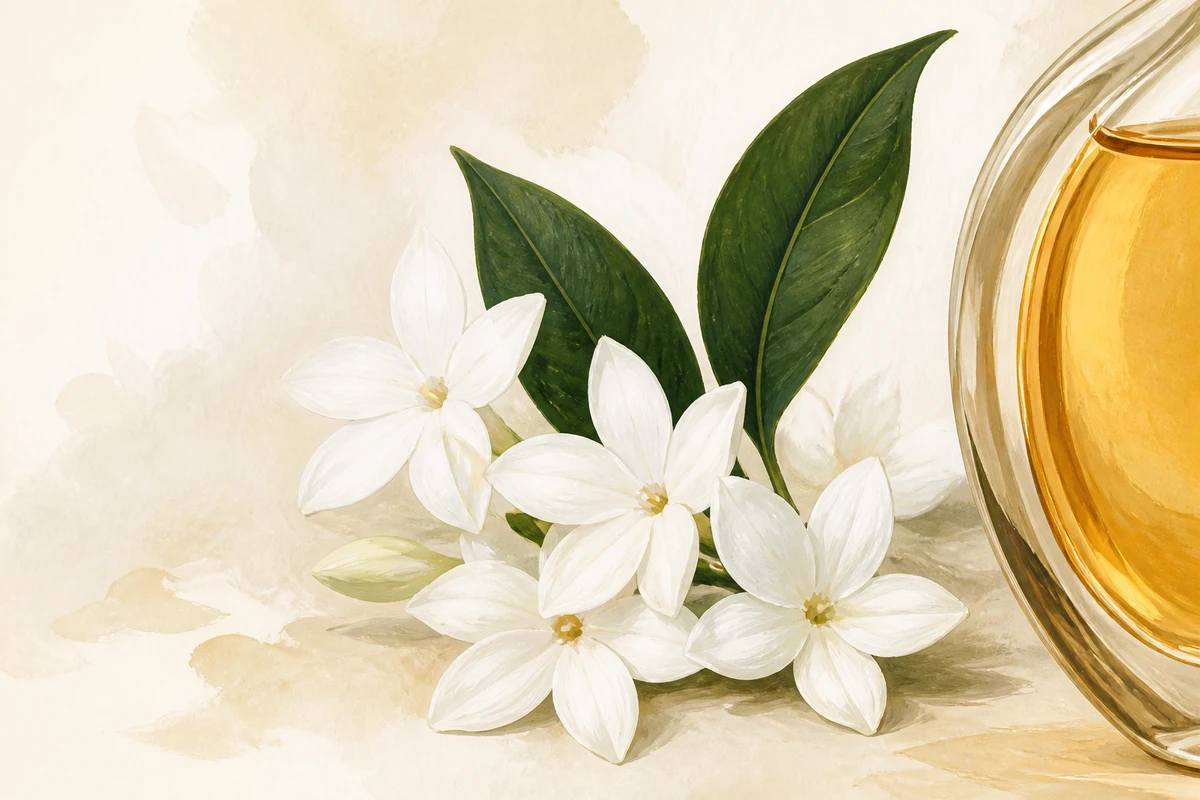
True Goddess is the fullest jasmine study in the collection because it is the only bottle that lists the flower twice: evening jasmine and plain jasmine together in the heart, beside plum, violet and orchid. The effect is a long, layered middle — fruit in front, violet’s softness in the wings, and jasmine carried twice so it does not thin out halfway. On a warm base of musk, vanilla, cedar and blackberry, this is the creamy-velvet reading at its most deliberate.
Pink Encounter, Read Top to Bottom
Pink Encounter shows the opposite treatment: jasmine in its softest casting. Grape and blackcurrant lead, jasmine and Rose Taif Flower follow, and white musk, vanilla and cedar close underneath. Nothing pushes; the flower is present as quietness rather than presence, and the sunlight-and-laundry version of jasmine is exactly what people who “hate jasmine” have usually never met. It is also the lowest price point in the range, which makes it the affordable place to test that theory.
Black Aya, Read Top to Bottom
Black Aya is the heavy casting. Coffee and citrus open, then evening jasmine arrives among orange blossom and jade, and the base wraps musk and vanilla around patchouli. This is the darkest, most enveloping reading — jasmine at velvet, in the best sense — and worn beside Pink Encounter it teaches the article’s whole lesson in a single afternoon.
If Jasmine Feels Like Too Much
An honest paragraph for readers the flower has always defeated. Perception of white florals varies a lot between people — some noses read them as plush and welcoming, others as loud the moment they arrive, and neither group is wrong. If a white floral perfume has felt like too much in the past, the practical move is to look for bottles where jasmine sits behind fruit or green notes rather than at the front of the list: Pink Encounter and Hawthorn Blossom are the range’s two clear examples. One testing note while you are at it: give the softer castings a full wearing rather than a sniff at the counter — jasmine’s gentle versions reveal themselves in the heart, not in the first spray, and a ten-second encounter will always read them wrong. And worth saying plainly: if jasmine still reads as too much after that, that is a valid preference, not a failure of your nose — the point of a note list is to find what suits you, not to win an argument with a flower.
What Does Jasmine Smell Like in Perfume: Common Questions
What does jasmine smell like in perfume?
Rich, warm and slightly sweet in one casting — clean, soft and soapy in another. The flower itself is a vivid white floral; the version you meet depends on its neighbours, and it can range from the softest reading on this site (Pink Encounter) to the heaviest (Black Aya) while being the same note throughout. That chameleon quality is worth remembering the next time you see the word: it is a promise of a flower, not of a specific smell.
Is jasmine perfume sweet?
It can be — jasmine has a natural sweetness that fruit and vanilla bring forward — but it is not a dessert note. Beside fruit it reads softly sweet; under spice it sharpens; over warm musk and amber it turns creamy rather than sugary. When a jasmine appears sweet, look at the base; that is usually where the sweetness was decided.
Is jasmine masculine or feminine?
Neither. Three of the seven jasmine bottles in this range carry the men’s and unisex tags, and what differs between all seven is the base under the flower — not the flower itself. The idea that jasmine belongs to one audience is a shelving habit, not a fact about the note. Wear the version you like; the shelves will sort themselves out around you.
Why does jasmine smell so different from one perfume to another?
Because the flower takes its colour from context rather than holding one of its own. Surrounded by fruit it softens; beside greens it cools; over warmth it turns velvety; in a structured base it becomes architectural. Nothing exotic is required to explain it — read the neighbours on the note list, and you can predict which jasmine you are about to meet before you even open the bottle.