
How to describe a perfume is a stranger problem than it looks, because colour and taste come with everyday names and smell does not. There is a word for sky-blue and a word for sour; there is no word for the smell of the room you are sitting in. So people borrow — from texture, from temperature, from food — and when the borrowing runs out, they say it smells nice about something they could describe perfectly well if anyone had handed them the tools. The difficulty was never in the smelling; it was always in the saying.
That is all this page is: the tools. Nothing here requires a trained nose or a special talent — just four pairs of words that do most of the work, a handful of texture terms, a short list of words worth retiring, and one method you can run on any fragrance you meet. It is the skill behind every other page in this series, which is why describing fragrance properly is worth half an hour of anyone’s time. None of it is complicated, and most of it is older than perfume criticism itself — the goal is simply to move from I like it to a sentence that tells another person what you smelled.
Four Pairs That Do Most of the Work
Most perfume scent words people reach for, when they reach at all, fall somewhere along four simple axes. You do not need all four at once; one good word per conversation is usually enough to be understood. But knowing the pairs means you always have somewhere to point — and the range’s ten bottles happen to furnish a clean example for each axis below.
Sweet ↔ dry. Sweetness arrives from honeyed, vanillic places; dryness from woods and mosses. The honeyed, softly powdery base of 1957 sits at one end; the dry cedar-and-oakmoss finish of Napoleon Eau sits at the other. When something reads neither, it is usually sitting politely between — and that is a description too. Read the base row first if you like: this axis is most legible there, where the two poles stand furthest apart. If you find yourself drawn to the dry end, the woody family is the shelf to browse.
Warm ↔ cool. Warmth comes from resins and deep balsamic notes; coolness from green leaves, citrus and violet. The resinous warmth under Lily of the Valley No. 7 — amber and frankincense in its base — is one pole; the violet, lemon and green-leaf side of Hawthorn Blossom is the other. Same idea, opposite ends: one wraps you, the other stands back. Temperature is also the axis most tied to season for most people — cool greens feel like spring, warm resins like the end of the year — which makes it an easy one to practise on the world outside perfume.
Close ↔ loud. This axis is about distance, not quality. Pink Encounter’s white musk stays at conversation distance; Napoleon Eau, the boldest composition on site, fills a room. Both are useful things to be able to say — and the difference between them is often what people actually mean when they call a scent too much or too little. Practise this one with distance in mind: spray something, step three paces away, and ask whether it is still with you. Near or far — that single gesture will make you fluent faster than any list.
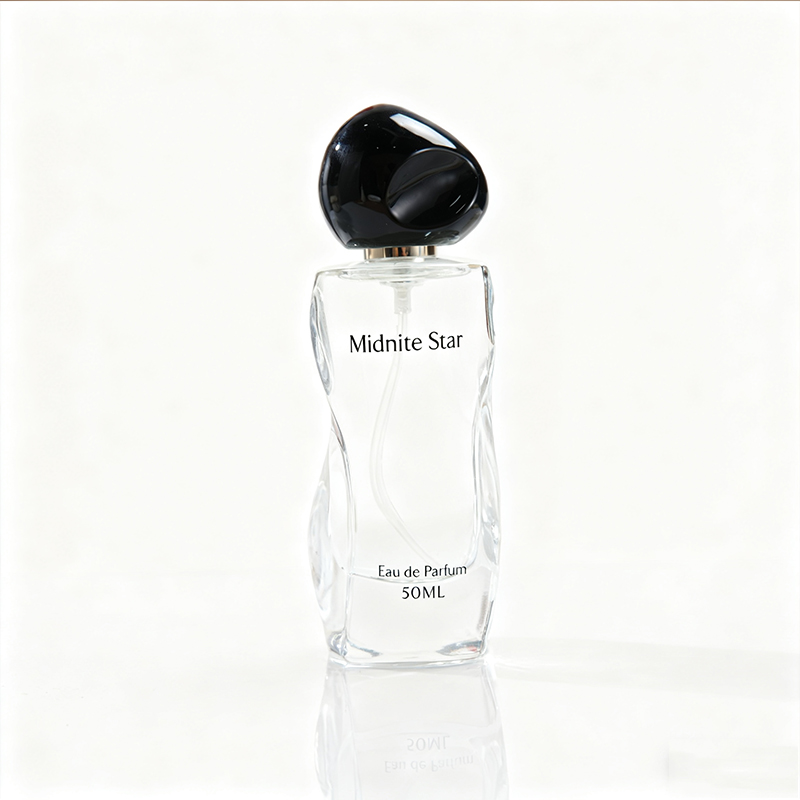
Smooth ↔ sharp. Texture again: the powdery, creamy finish of 1957 against the crisp mint-and-grapefruit opening of Midnight Star. Sharpness usually lives at the top of a composition and smoothness at the bottom, which is why the two words rarely describe the same moment — but both are worth having. This is also the axis that most explains personal taste: you will almost certainly prefer one end of it, and knowing which end is half of knowing what to try next.
Texture Words, Which Are Their Own Category
Some of the most useful perfume vocabulary describes not what a scent smells of but how it feels. Powdery, creamy, soapy, green, resinous, suede-like: each names a texture your nose recognises instantly, even if your vocabulary drawer was empty five minutes ago.
These are not invented words — this site uses them about its own bottles. The finish of 1957 reads powdery; Hawthorn Blossom reads green; the base of Lily of the Valley No. 7 is a suede. One-line glosses, in order of difficulty: powdery is the trickiest, a soft dry texture with almost no everyday source; creamy and soapy are its gentler cousins; green is the smell of cut stems and shade; resinous is warmth that feels thick rather than sweet; suede-like is the softest of the six, a texture more felt than smelled. When a word is already doing honest work in a product description, it will do honest work in your description too — and the whole set installs itself in an afternoon of comparing bottles side by side.
Words Worth Retiring
There is a small set of words that feel like descriptions but are not: synthetic, cheap, old-fashioned, chemical, and anything shaped like it smells like some other brand. Each of them describes a reaction rather than a smell — a verdict, not an observation — and verdicts close conversations while observations open them.
To be clear about what this is not: none of those words is a crime, and none of this is about taste or quality or the people who reach for them. It is about usefulness. If you say a fragrance is synthetic, the person across from you learns nothing about what you smelled; if you say it reads sharp to me, or it is much sweeter than I expected, you have handed them your actual experience — and usually started a better conversation. The fix for a banned word is almost always the same: name the axis instead.
Try the swap once, and see how the temperature of the conversation changes. Replace it is cheap with it reads thin and sharp to me. Replace it is old-fashioned with it turns drier and darker than what I usually wear. Both versions carry the same information — but only one of them gives the other person something to reply to, and only one of them could be wrong in an interesting way.
A Four-Step Method for Any Fragrance
Four steps, in order, and you have a complete answer to how to describe perfume smell — no expertise required and no vocabulary beyond this page. Run it once on a fragrance you know well, and the order will stick.
One: find the family. Families are broad neighbourhoods — floral, woody, oriental, fougère and the rest — and placing a fragrance in one narrows everything that follows. How the fragrance families differ maps them properly; or, if you prefer shelves to theory, you can browse by fragrance family directly.
Two: read the base row of the note list. The base is what you will actually spend the day wearing, so it anchors the description more reliably than the opening. How to read a note pyramid covers the layer logic in detail. As a shortcut: if the base is a wood or a resin, expect the description to lean dry and warm; if it is musk or vanilla, expect close and smooth. The base row is a set of hints about every axis at once.
Three: pick one word from each axis. Sweet or dry, warm or cool, close or loud, smooth or sharp. Four words, and you already have more description than most reviews. The odds that all four are wrong are effectively zero; the odds that all four are perfect are also low, and nobody is scoring.
Four: add one comparison from outside fragrance. A material, a place, a drink — anything the listener can imagine. This is the step that turns vocabulary into communication.
Worked through once: Black Aya is floral and fruity by family, with a base of musk, vanilla and patchouli — so it reads dark, warm, close and smooth. Coffee and citrus sit above the heart’s orange blossom and evening jasmine. And the outside comparison: it is closer to dark chocolate than to a cup of coffee. See what the comparison does that the notes cannot — it tells a listener what experience they are signing up for. That is a full description of a fragrance, built from four steps and no expertise.
And that is the whole method: a family to shrink the space, a base to anchor it, four words to sketch it, one comparison to make it travel. Nothing in it requires the trained vocabulary this page set out to replace — which was the point all along.
Building the Vocabulary in a Week
Deliberately small, because small is what works. This week, describe just three things you already own — a soap, a shampoo, a candle, a tea you drink — using the same axes as above: sweetness, temperature, distance, texture. One word each. You will be surprised how often you can answer; you will also find that naming is the part you were missing, not vocabulary.
Then reread the notes this collection actually uses with your new words in hand, and see which entries suddenly mean something. The range is unusually helpful here: it contains a tea composition to hold up against the actual tea in your cupboard, and a green floral to hold up against whatever green thing sits on your windowsill. And if you want proof that the method travels, apply it somewhere unexpected: tonight’s dinner, your laundry detergent, the air after rain. The vocabulary is not a perfume skill; it is a describing skill that perfume happens to train best.
If You Cannot Smell the Notes
A reassurance for the many readers who finish a note list and think: I could not pick out six separate notes to save my life. Almost nobody can — that is not a failing, and no note list was ever meant as a test. The list is a map of how a composition is built, not a checklist of what you must detect. If the list seems to describe a different fragrance than the one on your wrist, that is usually not you, either: compositions read differently in different rooms and on different days, and even professional descriptions wobble at the edges.
What you can always do is name the family, the base and one axis word — and that is a complete description. “A dark warm floral that sits close” is every bit as legitimate as anything a reviewer writes, and considerably more honest than most. The rest of the phrasebook arrives on its own, one bottle at a time.
How to Describe a Perfume: Common Questions
How do I describe a perfume smell?
Start with the easy questions, one at a time: is it sweet or dry in your reading? Warm or cool? Does it sit close, or fill the room? And is its surface smooth or sharp? Give one word from each pair, then add a single comparison to something outside fragrance. Family, base and one comparison — that is already a fuller description than most people manage, and it takes about a minute.
What words should I use?
Words that name a sensation rather than a verdict: the axis words above, the texture words like powdery and green, and honest comparisons. Words to leave in the drawer: synthetic, cheap, old-fashioned, chemical, and any version of it smells like some other brand — they report a reaction instead of a smell.
Why can’t I smell the notes I read about?
Because most people cannot pick out six separate notes, and note lists were never designed as an exam. The list is a map of the composition; your job is only to say where you are on it — family, base, one axis word. That is a complete answer, and precision comes with practice rather than talent.
What does powdery mean in a perfume description?
It names a texture, not a flavour: something soft and dry that sits on top of the composition, like the surface of a pressed powder, rather than a smell you can point to a source for. The clearest example in the range is the finish of 1957, where the powderiness arrives late and settles in rather than announcing itself.