
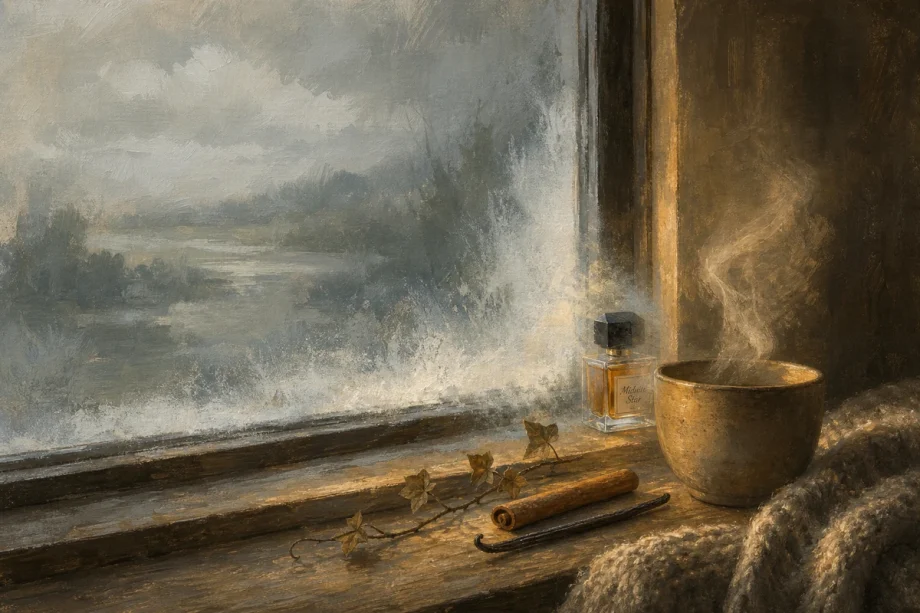
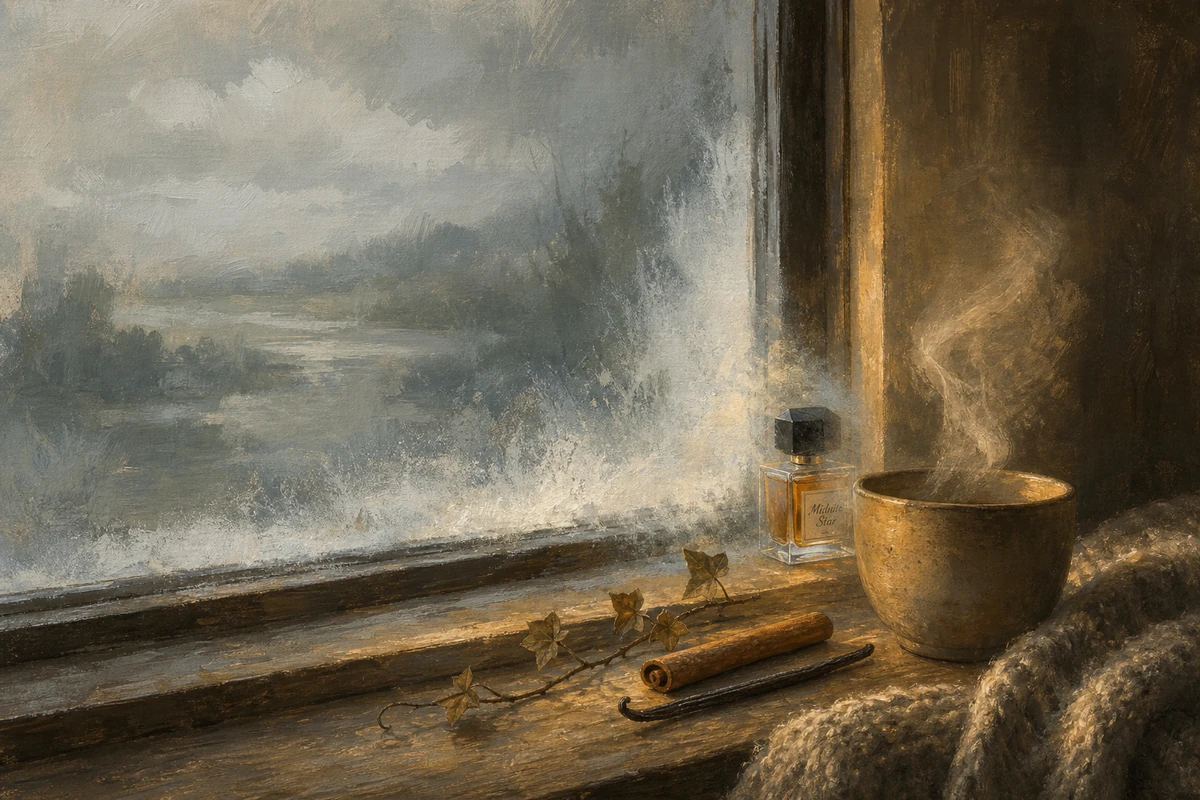
There is a particular disappointment that arrives in late October: the bottle that behaved perfectly in May suddenly feels thin, short, or oddly sharp. Nothing about the perfume changed — its formula, its bottle and its price are exactly what they were. What changed is the air around you and the layers between you and the world, and fragrance is unusually sensitive to both. Understanding cold weather perfume is mostly a matter of understanding the conditions it is now working in — and the good news is that those conditions are ordinary, predictable, and easy to work around once you can name them.
If you have been going through your shelf season by season, deciding what still works this season is the companion piece to this one; here, we stay on the mechanics — why scent behaves differently in the cold, and the small adjustments that make the cold half of the year work. Three variables do most of the explaining: dry air, cool air, and clothing.
The Three Variables, Up Front
Dry air — indoors from heating, and on skin that holds less moisture than it did in summer — makes a fragrance read thinner and leave sooner. Cold air changes how scent travels: the still, cool outdoors is not the same stage as a warm, moving room. And clothing layers put fabric between the perfume and the people who are supposed to notice it. Everything below is a consequence of one of those three, and so is every fix. None of them is exotic — all three are everyday parts of a winter day, and each responds to a change you can make in under a minute.
Dry Air and Drier Skin
Start with the most common mystery: the perfume that used to last all day now seems to vanish by lunch. Indoor heating dries the air, and heated air pulls at skin moisture too; it is widely described — rather than settled science — that drier skin releases fragrance faster and less evenly, which presents as a scent that goes quiet early or feels thinner than you remember. The fix is not more perfume. It is a better surface: moisturise before spraying. An unscented cream or lotion, applied a minute or two before the fragrance, gives the composition something to hold onto, and it is the single change most cold-season wearers need.
The second half of the same fix is reapplication — but later, not louder. Rather than doubling your opening dose, plan to refresh once in the later afternoon if the day is long. A fragrance that fades from a good start is easier to top up than one that began as too much. And if you are choosing what to wear in the cold at all, know that scents built to sit close to the skin — a musk-and-vanilla base rather than a bright opening — cope with dry air noticeably better than anything that depends on sparkle.
There is also a rhythm worth borrowing from people who wear scent well in winter: lotion first, fragrance second, both applied while skin is still lightly warm from the morning shower. The pattern to watch for in yourself is a fragrance that opens richly and then narrows quickly — that is usually a dry surface talking, not a weak formula.
Cold Air and Projection
The outdoor story is different from the indoor one, and the difference trips people up. Cold, still air both slows and quietens the scent around you: people standing close to you outdoors may notice less than they would in summer, because the air is not moving the way warm air does. Step into a heated room, though, and the same application suddenly blooms — warmth and movement lift the fragrance off your skin, and a modern flat can amplify what a street corner muffled.
The practical consequence is counter-intuitive: judge a winter application indoors, not on the way out of the door. If a spray feels right in a warm room, it will be right — lighter than you think outdoors, but never invisible. What to avoid is over-applying for the street and then spending the evening in a warm room, where the extra dose is exactly what makes people describe winter perfume as heavy. Apply for the indoors; the cold will take care of toning it down.
There is a broader point hiding in this: in winter, most of your audience is indoors too. Offices, trains, kitchens and living rooms are where the day happens, and they are warm, moving environments where scent travels further than the street ever lets it. Outdoors, a winter fragrance is mostly a private pleasure — close to the skin, mostly for you. Calibrate for the rooms, and the street looks after itself. What is left behind as you move between those rooms is a separate subject — how far a fragrance travels, as distinct from how strong it is while you stand still.
Clothing Layers
Most perfume is applied to the wrist, and in the cold half of the year most wrists spend the day inside a sleeve. The exposed-wrist habit is a summer habit: it assumes bare skin and moving air. In winter, the positions that actually carry scent are the ones where body heat and fabric work together — the chest, the collarbone, the back of the neck, against the collar of whatever you are wearing.
The honest trade-off: fabric holds fragrance longer than skin does, which is exactly why some people spray their scarves and coats. But not every fabric should be sprayed. Silk can spot, pale colours can mark, and delicate or dry-clean-only pieces are better left alone. The safe layer is the one next to the skin: apply to warm skin points under your clothes, and let warmth move the scent up through the neckline. If you do want scent on fabric, choose a dark, hard-wearing inner layer where a mark would never show. And apply to the layer you will keep on — scenting a coat you will hang up at the door is scenting a stranger’s evening, not yours. A scarf worn over a scented collarbone picks the fragrance up without being sprayed at all; sometimes that passive transfer is all the fabric effect you need.
What Reads Better From October Onward
Cool air flatters some materials and exposes others. What people are really asking when they shop for the best perfume for cold weather is a question about materials — and the ones that read best in the cold are those with weight in the base: woods, resins, amber, vanilla, patchouli and musk. Amber is the warmest of them, and what amber smells like explains why no two amber-led bottles read alike. Bright citrus and marine notes are the hardest sell — not impossible, but they depend on the warmth and movement that the season takes away. This is not about which perfumes are better; it is about which compositions the season gives room to. The range has four good illustrations of the warm side, each in its own register.
Midnight Star is the template: a bright opening of grapefruit, lemon and mint that the cold quickly hands over to ginger, nutmeg and jasmine, before settling into cedar, musk and sandalwood — a fragrance with a warm second half and a third. Napoleon Eau is the densest composition in the range — lemon, pink pepper, apple and blackcurrant over pineapple, jasmine and patchouli, landing on birch, ambergris, cedar, oakmoss and musk — and it is the best example in the range of what a cold-weather composition looks like on a note list. 1957 takes the warm route without any dessert: pink pepper, coriander and bergamot over orange blossom and jasmine, with vanilla, honey, musk, cedar, Kashmir wood and iris root below. And Black Aya is the skin-close option — coffee and citrus over orange blossom, evening jasmine and jade, on musk, vanilla and patchouli — for the kind of winter warmth that reads as personal rather than perfumed. Coffee is doing quiet work at the top of that composition, and what coffee smells like in perfume covers why the note reads creamy in some bottles and dry in others.
If that is the direction you want to browse, the shelves to walk are simple: woody fragrances and oriental and ambery fragrances are where the cold-season materials concentrate. The pattern to look for on any note list, here or elsewhere, is weight in the last row: resin, wood, amber, musk, vanilla, patchouli. None of this is a rule, though — personal taste overrides seasonal guidance every time. A bright citrus worn because you love it is better than a warm amber worn because a list said so.
Three Adjustments for the Cold Half of the Year
If you take nothing else from this piece, take the three changes, in order. First, moisturise before spraying — same fragrance, better surface. Second, move the application under the layers: skin on the chest or the back of the neck, where warmth and fabric will carry it, rather than exposed wrists. Third, if you change the dose at all, go by one extra light spray as the maximum — adding perfume is the last resort, not the first response. Together they cost nothing and ask nothing of your taste: the same fragrance, in the same week, simply behaves like a better version of itself. That is the entire method of how to wear perfume in winter: a better surface, a smarter position, a lighter hand. The broader mechanics — how long a fragrance actually lasts, on average, and which clocks apply — are set out separately in how long a fragrance actually lasts, so this article can stay on the cold-weather side of the question.
Layering as a Cold-Weather Tool
One technique genuinely belongs to this season: layering, used as a way to add warmth under a bright scent rather than to make something louder. A citrus or a light floral worn over a soft vanilla-or-musk base reads rounder and stays coherent in cold air, where the same scent alone can feel exposed. The pairing logic is simple — soft vanilla, musk or amber underneath; the bright, tea or floral note you love on top — and the method is worth learning once: layering a warmer base underneath is our walkthrough. But the idea is the part that matters in winter: base first, brightness second, the reverse of how people usually improvise. If you want a one-line winter fragrance guide, it is this section and the one above: warm base, light hand, skin under layers.
Storage and Temperature Swings
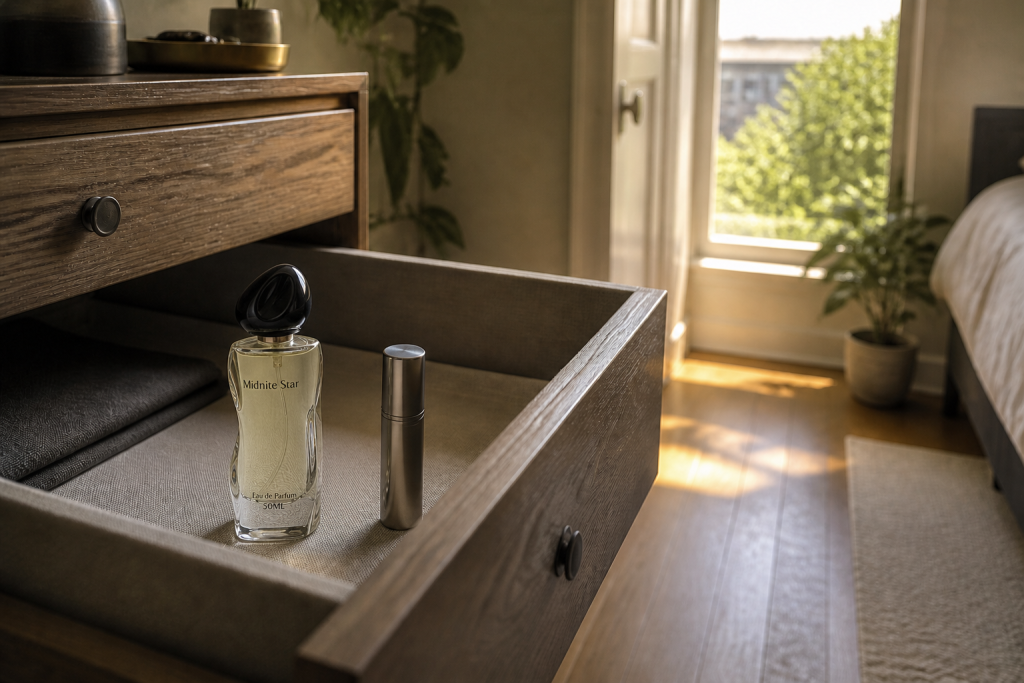
On the bottle itself: cold is not the enemy. What perfumes dislike is repeated temperature swings, direct light and heat sources — so do not leave a bottle in the car overnight, and do not park it on a radiator or a sunny windowsill. A stable, dark, room-temperature shelf is all the care the bottle needs; a drawer or a closed box works exactly as well as anything fancier, because darkness and steadiness matter more than the container. The weather outside can do whatever it likes.
Cold Weather Perfume: Common Questions
Does perfume last longer in winter?
Not reliably. Cool air can make a scent seem quieter and slower, but heated indoor air dries skin and the air around it, which tends to shorten the wear — so for most people the two effects cancel out or reduce duration overall. Judge it on your own skin, indoors, rather than on the season, and remember that the two habits above — moisture first, a single later top-up — are what actually move the number.
Why does my perfume smell weaker in cold weather?
Two things at once: cold, still air carries scent less actively around you outdoors, and dry heated air makes skin release fragrance faster, so what remains is thinner. Reapply once later in the day rather than doubling up, and moisturise before you spray. If the scent still reads faint by evening, the likelier fix is a composition with a heavier base rather than a heavier hand.
Should I spray perfume on my coat?
Better not to — coats and scarves are often the worst fabric to mark, and darker, hard-wearing layers fare better than pale ones if you must. The safer version of the same idea is spraying warm skin under your clothes, where the fabric carries the scent without holding any stains. If you want the scent to reach the people who hug you, the compromise most people land on is one light spray on a dark, sturdy inner layer’s collar area — just know that the coat, not you, will be carrying it.
Is a heavier fragrance better for winter?
Only if you like heavier fragrances. Warm, base-heavy compositions read more naturally in cold air, but a light scent worn indoors — where you spend most of the day — can be exactly right. If you have both kinds, wear the warmer one on the coldest days and the lighter one indoors; if you have one bottle, adjust position and dose rather than replacing it. The honest answer is the one this whole guide keeps returning to: conditions change how a perfume behaves, but preference decides what you wear.