
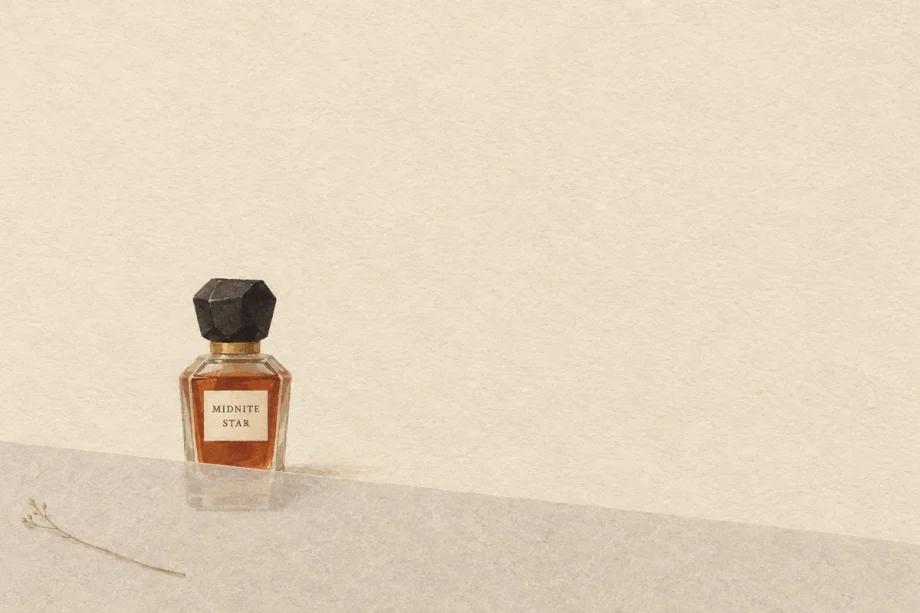
The bottle goes on before you leave the house, and by mid-morning it has disappeared. You lift a wrist, find nothing, and the hand begins moving back toward the bottle. That small reach is where most people decide their perfume no longer lasts, and it is also the moment the question — why can’t I smell my perfume — gets answered in the least useful way available: with another spray.
Most of the time the scent is still there. What changed is your attention to it, an everyday effect this site names elsewhere as olfactory adaptation, or nose blindness. The fragrance has not left the room; the nose has stopped reporting on something it has been exposed to without a break. Understanding that difference changes what you do next, and it is the whole argument of this piece.
What Is Actually Happening
When a smell is with you continuously, it stops being information. Attention is drawn to change — a new room, a new person, a bottle opened for the first time — and a smell that stays exactly the same gives attention nothing to work with. The nose is not failing. It is doing with a constant smell what it does with anything constant: treating it as the baseline against which everything else is measured.
This is why the sense of loss usually arrives after the bright part of a composition has passed. While the opening is changing, you notice it. Once what remains is steady — the quiet middle, the settled base — there is no change left to report, and the fragrance slides into the background of your own day. It is still on your skin and still in the air around you. It has simply stopped being news.
The effect has nothing to do with the quality of a bottle. A composition that sits close will drop out of your awareness sooner than one that fills a room, but both can be perfectly present. And the situation is asymmetric by nature: you are the only person in the room who has been smelling the same fragrance all morning. Everyone else meets it fresh, which is why their report and yours can differ so completely.
Four Ways to Check Whether It Is Really Gone
None of these requires buying anything, and each takes less time than the walk back to the bottle.
Step out, then come back
Leave the room for ten minutes — another room, a corridor, outside — and walk back in. The smell that meets you in the doorway is the one other people meet. If the doorway still carries it, nothing has gone; you had simply stopped noticing it at close range. This is the most reliable test on the list, because it resets the only instrument you have been using all morning.
Ask one person, and accept the answer
Choose one person standing at arm’s length and ask a direct question. Then take the answer without negotiating. If they say it is there, it is there — their nose is the fresh one, and yours is the one that has been living in the cloud. The temptation is to explain that you cannot smell a thing, which is true and also irrelevant: the question was never about your nose.
Reset with something neutral
Smell something neutral first — fresh air at an open window, the unperfumed inside of your arm, a clean cotton sleeve — and then return to the spot you sprayed. The neutral note restores contrast, and contrast is precisely what your nose has lost.
Test the base on a wrist you did not spray
Press a clean wrist against the sprayed one, then smell the clean one. What transfers is the dry-down: the part of the composition still working after the bright opening has gone. If anything at all is there, the perfume is still on you. This test also shows what a fragrance becomes later in the day.
All four tests answer the same question — is the fragrance still there — and none of them answers whether you like it. They are measurements, not verdicts.
The Trap: The Less You Can Smell, the More You Spray
This is where nose blindness becomes a habit. Because the morning application seems to have vanished, a second one at midday feels reasonable; because the second one also disappears, a third follows. Almost nobody decides to over-apply. They decide, repeatedly, that the perfume has gone.
The statement worth keeping is blunt: the person who cannot smell their own perfume is the worst possible judge of how much of it is in the room. Everyone else is working with a fresh nose; you are working with the one that has been in the cloud since breakfast. Your reading is not wrong about your experience. It is simply the least representative sample available.
The site’s guide to concentration makes the case for why restraint is the considerate choice, and that case rests on exactly this asymmetry. Restraint is not abstinence. It is accepting that your own reading of the room is the least reliable one you have, and adjusting for it rather than topping up against it. If you want the vocabulary for what other people meet when you move through a space, the recent piece on sillage covers that; this page stays with attention and dosage.
What to Do Instead of Reapplying
Apply less to begin with. If a single application has disappeared from your awareness by mid-morning, the answer is a lower baseline rather than a second layer. The first application is still doing its job; you simply can no longer hear it. Reduce the amount until it stays legible for longer, and let restraint rather than addition be the adjustment.
Choose a place you will meet again. A wrist you raise to your face, the area near a collar: placement decides whether a fragrance returns to you through the day or sits permanently in your attention. The product copy for this range is explicit that perfume can stain fabric, and that a garment should receive only a small amount, on a suitable area.
Rotate two fragrances. Two bottles in alternation stay legible in a way that one worn every day does not. The return to a scent after a day away restores the contrast that constant wear removes; you meet it again instead of living inside it. This is the least effortful fix on the list, and the one most people never try.
Treat the arm’s-length answer as the only measurement. Not the wrist at midday, not the memory of how strong it felt when you left the house. One fresh nose, one direct question, one answer you agree to accept.
Why Some Scents Slip Away Faster Than Others
Three bottles in this range show three different reasons a composition leaves your attention, and none of them is a fault.
Napoleon Eau is the clearest case of a finish that stays close. Lemon, pink pepper, apple and blackcurrant open it, and birch, cedar, ambergris, oakmoss and musk close it with what its own description calls “a long-lasting, mossy finish that stays close to the skin.” A composition that stays close is precisely the kind you stop registering: it is doing its work at a distance of centimetres rather than across a room.
Enchanted Fox is described as having “a refined, quietly romantic character” — rose and orange at the top, musk and woody notes in the middle, nougat at the base. A quiet composition is built to be met up close. It is not designed to announce itself from across a table, so it leaves your own radar earlier than a louder bottle would.
1957 runs “from a juice-bursting opening to a light, soft finish.” The opening is unmistakable and the finish is the part that becomes background, with white musk running through the whole composition — the kind of material that blends into a day rather than interrupting it.
The general rule behind all three: the more a composition concentrates its presence at the start, the more noticeable the quiet afterwards. That is structure, not failure. It also helps to know what the base is doing hours later: what the base is doing hours later explains why the last stretch of a fragrance is the quiet one.
None of this depends on the wearer. The range holds ten bottles — nine eau de parfums and one eau de toilette — and the differences between them are design decisions rather than questions of compatibility. If your complaint is specifically about close, quiet compositions, the close, quiet shelf gathers them; the shelf filed for anyone is the shop’s own filing for the bottles that do not assume a particular wearer.
When It Is Not Nose Blindness
Nose blindness is the most common explanation for a fragrance that seems to vanish, but it is not the only one. Rule these out before deciding that the bottle is at fault.
The bottle has been stored badly. Heat and light are unkind to perfume. A bottle that has spent a summer on a sunny shelf or in a warm bathroom may genuinely have changed.
It went on dry skin. A fragrance applied to skin that is very dry can seem to go quiet sooner. That is a matter of surface rather than composition, and one reason two people can wear the same bottle and report different days.
It has been on for hours. By late afternoon, something applied in the morning may simply be finishing. That is the composition completing rather than your nose adapting.
It was a light composition to begin with. Some bottles are built to be close and soft. Expecting one of those to behave like a dense, expansive fragrance is a category error rather than a disappointment.
Air belongs on the list too: how air and skin change what you notice covers how cold air, indoor heating and extra layers alter what a fragrance does over a day. Two older pieces on the site approach this ground from other directions — the one on how long perfume lasts, and the list of application tips — and both are about practice rather than attention.
Why Can’t I Smell My Perfume: Common Questions
Why can’t I smell my own perfume?
Because you have been inside the same cloud all day. A constant smell stops registering while people who meet it fresh still notice it. In most cases the fragrance is present and your nose has stopped reporting it, which is a difference in attention rather than in the bottle.
Is nose blindness a real thing?
It is an ordinary, everyday effect rather than a condition. This site calls it olfactory adaptation, and the useful part of the name is the idea of adaptation to something constant — nothing in it speaks to the strength of the perfume.
Does it mean my perfume is weak?
Not by itself. Close, quiet compositions drop out of your awareness sooner than expansive ones, so the test is what someone at arm’s length can smell, not what you can find at your own wrist later in the day.
Should I reapply when I stop smelling it?
No. Check first — step out and come back, or ask someone nearby. If the answer is that it is still there, the fix is a lighter application next time rather than a second one now.
Test first, then decide, because the bottle is usually still doing its job.