
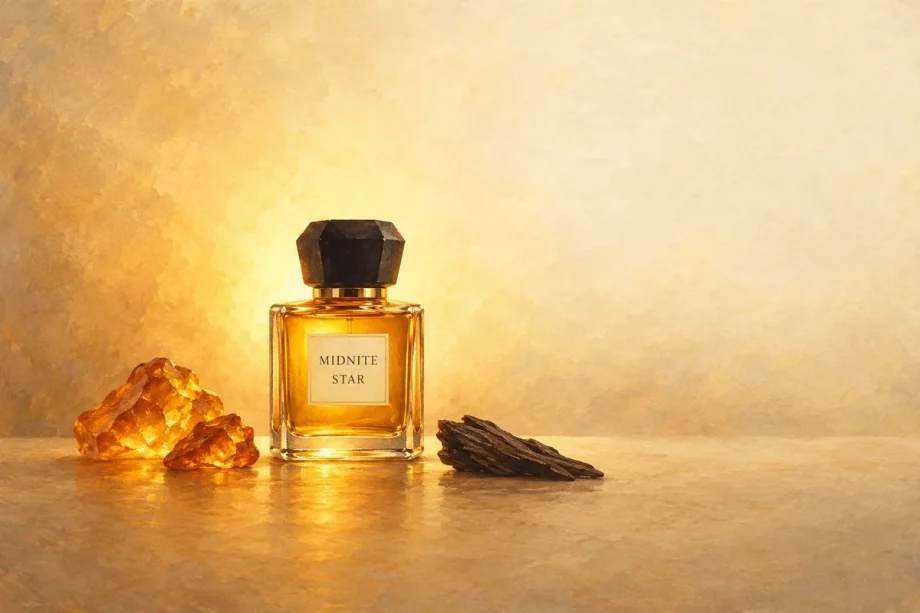
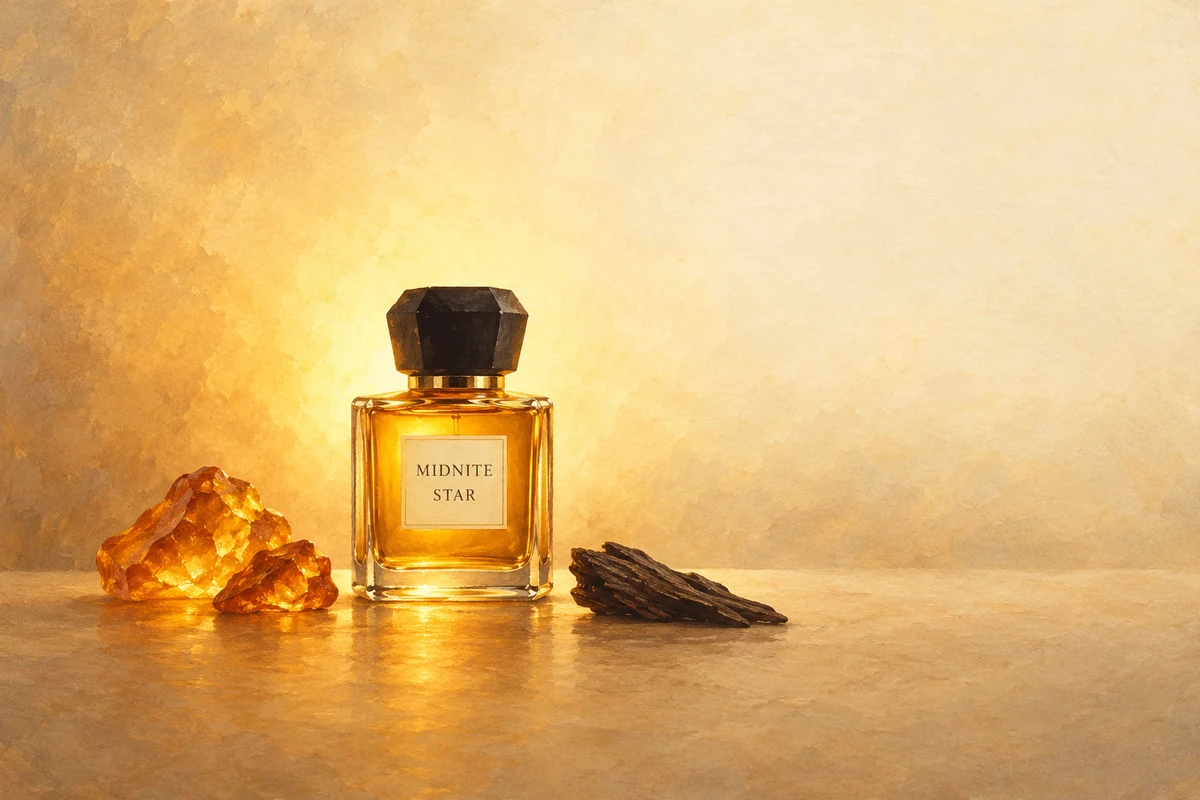
What does amber smell like in perfume? Warm, rounded, resinous and softly sweet — closer to a glow than to any flower or wood you could point at, and softer at the edges than almost anything else in a bottle. It is also the word readers meet most often without ever having it explained, which is exactly why it deserves its own piece rather than another passing mention.
The Midnite Star range holds ten fragrances, and exactly one of them names amber in its notes — Lily of the Valley No. 7. But look across the site and the word is everywhere: amber appears over a hundred times as supporting evidence in other articles, quietly doing its job in descriptions of warm endings, and never once being defined. This piece fixes that — what amber reads like, what it does in a composition, and why two amber fragrances can smell like two different genres.
Amber on a Note List Is a Promise About Warmth
Here is the idea the whole subject turns on: amber on a note list is not a recipe — it is a promise about warmth. It is a warm accord rather than a single material, a constructed idea of golden softness that perfumers reach for when a composition needs to end enveloping rather than dry. Read it that way and its behaviour makes sense: a base built around amber feels plush and rounded, everything above it seems to soften at the edges, and the whole fragrance finishes with a sweetness that never quite becomes edible.
That last distinction matters more than it sounds. Amber is sweet the way soft light is warm — a quality rather than a flavour. You will not catch it being syrupy, and you will not catch it being sharp. What you will catch, if you pay attention, is its effect on its neighbours: fruit stops being tart, spice stops being hot, woods stop being angular. The amber note in perfume is one of the great diplomats of the base, and once you have smelled a composition with and without that golden cushion, you will recognise it everywhere.
It is worth pausing on how unusual that role is. Most notes are hired for what they add; amber is often hired for what it prevents — dryness at the bottom, harshness in the transitions, an ending that arrives too abruptly. A composition reaching for amber is frequently not trying to say amber at all. It is trying to make sure nothing else in the formula says too much, and the warmly finished result is the proof.
Amber vs Ambergris, Kept Short
Two words that look related and confuse nearly everyone: amber and ambergris. They do share an atmosphere — both live in bases, both are associated with depth — but they are different things. Amber is the warm, resinous, softly sweet accord described above. Ambergris is a different material with a saltier, more mineral character; where amber feels like honeyed light, ambergris feels like sea air on stone. The range shows the split cleanly: Lily of the Valley No. 7 names amber in its base, while Napoleon Eau names ambergris in its base. Two bottles, two endings — and if you ever want the ambergris vs amber question settled by your own nose, those two are the experiment worth running.
Why No Two Amber Scents Smell Alike
Because amber is a warmth rather than a scent, its personality is set by whoever sits beside it — and the note list tells you which company it keeps. Vanilla, tonka or honey pull it sweeter and more edible; pairings like those turn amber in the direction of dessert without quite arriving there. Frankincense, suede or dry woods keep it smoky and austere — the same warmth, but dressed in shadow. And oakmoss or other mossy materials give it a darker, older feeling, the kind of base that reads like a room that has been furnished for decades.
The method is two lines long, and it works anywhere you can read a list: find the amber, then read its three or four closest neighbours in the base row. Sweets pull it golden and rounded; incense and leather pull it shadowed; moss pulls it old-world. That is the whole trick to predicting what a warm resinous perfume will actually smell like, and it explains the title of this piece — two amber fragrances differ because two ambers were given different instructions. It also explains why amber lovers end up owning bottles that seem, on paper, to have nothing in common: an amber beside honey and an amber beside moss are cousins in name only, and the note list is the only place that distinction lives in writing.
Where Amber Sits and What It Does
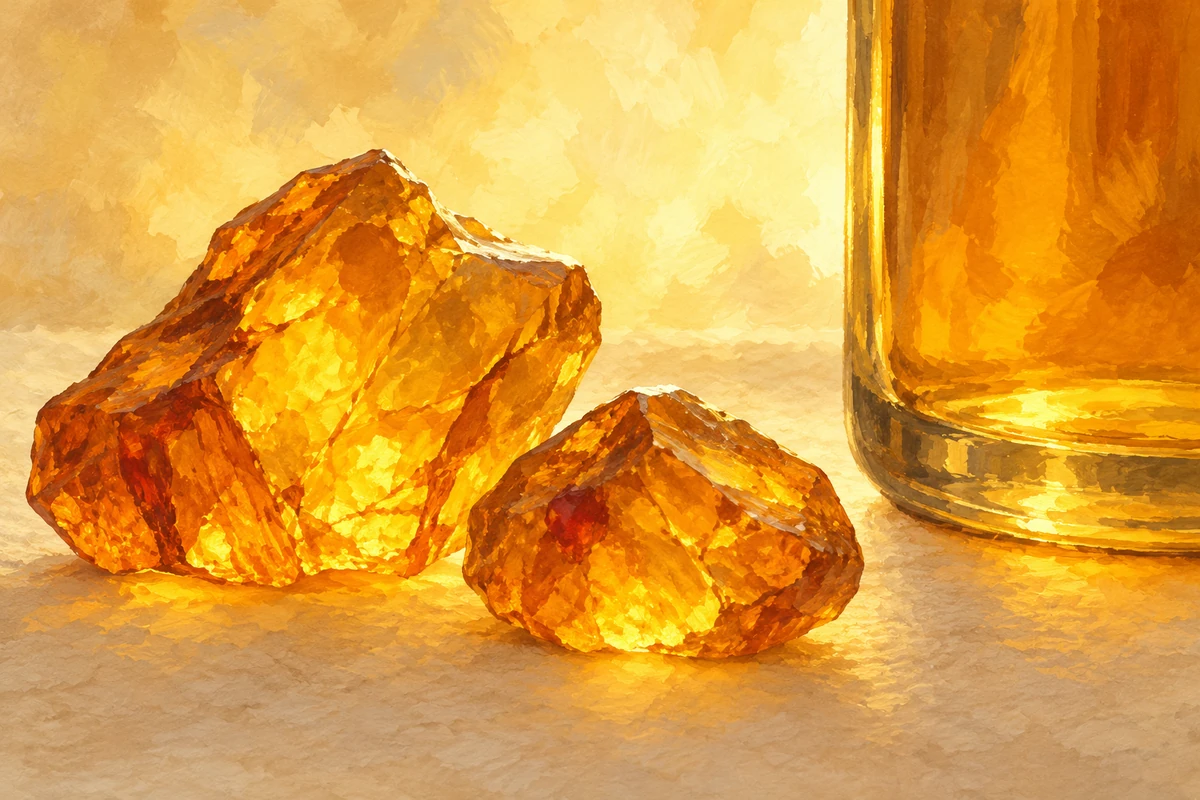
Amber lives in the base, and it rarely announces itself. Its job is to be the material that makes a fragrance finish quietly rather than sharply — the difference between a door closing softly and a door clicking shut. It does not project, it does not sparkle, and it almost never leads. What it does instead is absorb: the sugar of a fruit note, the edge of a wood, the flash of an opening that has spent itself. Many of the impressions people describe as powder or softness arriving after two hours are amber doing its work in the background.
Position is the thing to internalise here, because amber is one of the clearest arguments for reading note lists from the bottom up. If you are still building that habit, how to read a note pyramid explains why the base row carries so much of a fragrance’s character — and amber is the ideal practice material, because its effects are consistent even when its ingredients are not. One habit worth building: when you meet a fragrance described as warm, golden or enveloping, go looking for amber in its base — an amber note perfume rarely leads with its amber, but it is usually the reason the description says warm at all.
Two Amber-Reading Bottles from the Range
Lily of the Valley No. 7 — the One That Names It
Lily of the Valley No. 7 is the only fragrance in the range that names amber outright, and it is an Eau de Toilette — the single EDT here, and worth saying clearly because it makes the composition lighter than its warm base would suggest. Under a fresh, green-floral body — thyme and tea up top, lily of the valley, saffron and rose at the heart — the base of suede, musk, sandalwood, frankincense and amber builds a warm resinous ending that arrives quietly beneath all that freshness. It is the clearest demonstration on site of amber as a finishing gesture rather than a statement. The full composition is on Lily of the Valley No. 7.
Napoleon Eau — the Neighbour, Not the Twin
Napoleon Eau names ambergris rather than amber, which makes it the perfect contrast piece: its base of birch, ambergris, cedar, oakmoss and musk finishes saltier and more mossy — where the first bottle ends glowing, this one ends structured and cool, close to the skin. Smelled side by side with Lily of the Valley No. 7, the difference between the warm accord and the mineral material is about as clear as the range can make it. The composition is on Napoleon Eau.
And a third, lighter note from the shop’s own filing: Midnight Star sits under the woody and oriental families — the warm, dense end of the shelf — and if you want to know where ambers and their relatives live in the collection, that region is the map. The range’s other warm-resinous territory is collected on the warm, addictive end of the shelf and on browse the oriental family — two corners of the catalogue that exist precisely because this kind of warmth has its own following.
When Amber Reads Best
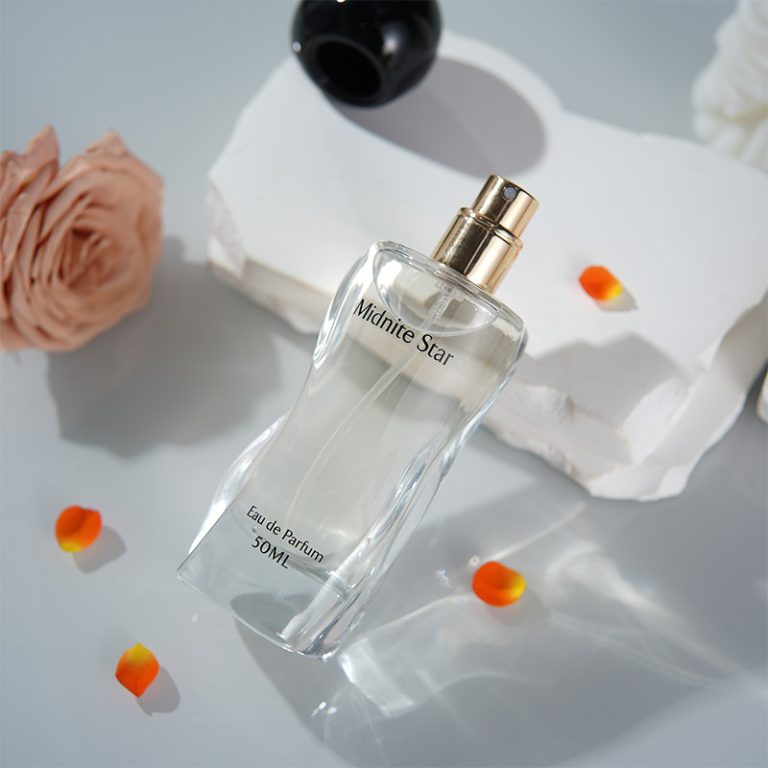
Amber is a cool-weather temperament by nature, and the honest reason is weight: its golden cushion suits cold air and low light, and the same base that feels enveloping in November can feel like a coat indoors in July. That seasonal pull is real enough that the range’s own ambers and ambergris all sit in its denser half, and if you want the wider picture of how temperature shapes wearing, perfumes for cold weather is the companion read. One more practical note: because amber bases sit close and hold, a fragrance built on them often wears longer than its opening promises — the bright first half hour is not the story, it is the invitation.
There is a quiet advantage in that for anyone assembling a small wardrobe of scent: a warm resinous base does the work of making a fragrance feel finished, which means you can judge bottles by their endings and trust that the ending is what you will live in. Openings are loud and brief; amber is the part that stays, and it rewards being chosen deliberately.
Who Tends to Like It
Amber splits people into two camps, and both are describing the truth. One camp reads it as plush and glowing — the sensation of warmth without heat, a base that makes everything above it feel finished. The other camp reads the same warmth as old-fashioned or even dusty, and that impression is worth taking seriously as an impression: it usually comes from amber sitting next to heavy mossy or leathery materials, which genuinely read older and darker. Neither camp is wrong, and neither is a fact about you — they simply describe different neighbours.
If you are shopping for yourself, the cheapest way to find out which camp you belong to is to sample across the neighbours: one sweet-companion amber and one smoky-companion amber, worn a few days apart. The texture is the same; the temperature is not — and texture, once loved, stops being a matter of debate. That is the quiet luxury of learning this note: it is one of the few places in fragrance where the shopping question reduces to a single base-row glance.
Which is why the way to know what you are buying is to read the base row around the amber, not the amber itself. Three or four materials tell you everything: sweet companions promise a golden softness, incense and leather promise shadow, moss promises history. Read those first, and you will know which camp a bottle belongs to before the question ever reaches your nose.
What Does Amber Smell Like in Perfume: Common Questions
What does amber smell like in perfume?
A rounded, resinous warmth with a soft sweetness — closer to a glow than to any single flower or wood. Amber is an accord rather than a single material: it lives in the base, and its exact character is decided by the notes around it.
Is amber a single ingredient or a blend?
It is better understood as an idea of warmth than as one ingredient — a warm accord built for a purpose, which is why amber perfume meaning is really about effect rather than recipe. On a note list, treat it as a promise: the finish will be enveloping, softened and softly sweet.
What is the difference between amber and ambergris?
Amber reads as golden, resinous warmth; ambergris is a different material — saltier and more mineral. Both sit in bases and both add depth, but they pull a finish in opposite directions — golden on one side, oceanic and cool on the other. The range demonstrates both directly.
Why do two amber perfumes smell so different?
Because the notes sitting next to the amber decide its character: vanilla, tonka and honey turn it sweeter, frankincense, suede and dry woods turn it smokier, and oakmoss turns it darker and older. Read the three or four materials beside the amber in the base and you will know which version you are holding. For the wider family map of these warm structures, how the fragrance families differ picks up where this piece leaves off — and with the base row in hand, the next amber you meet will already be halfway explained.