
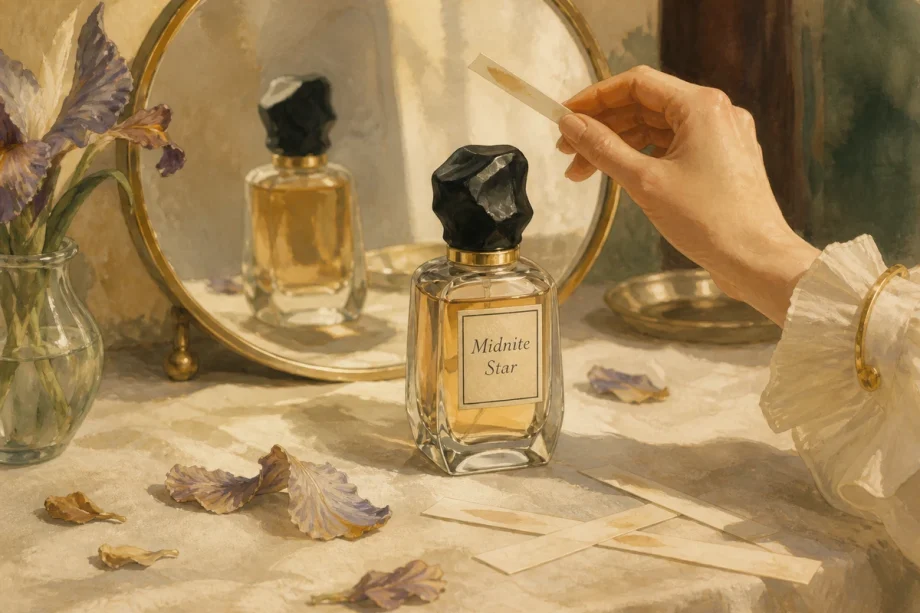
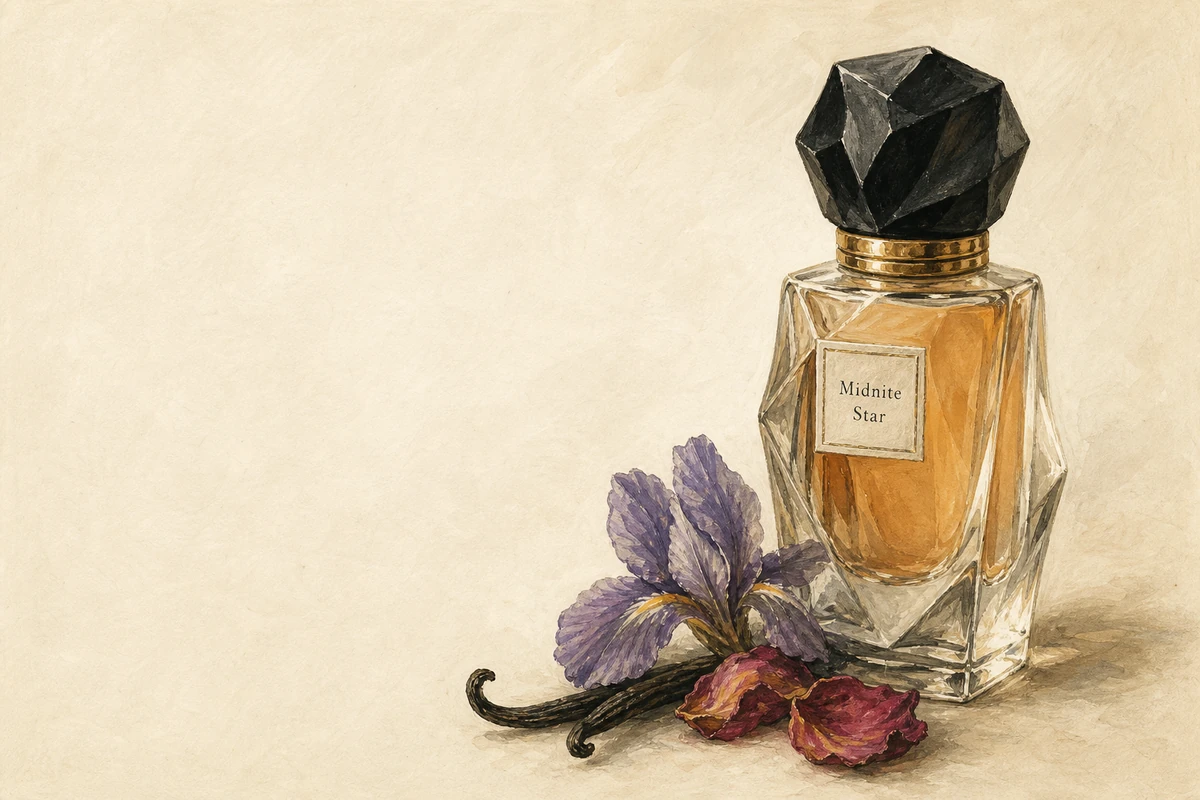
Why does perfume smell different on me? It is one of the most common questions in fragrance, and the most common reason a bottle that sang in the shop goes quiet at home. The honest answer starts with a reframe: a fragrance is not a fixed object. It is a sequence of materials, unfolding over hours, on a surface — your skin — that is different from every other surface it could land on.
Most cases of “perfume smells different on my skin” come down to three things: the conditions on your skin when you spray, the amount of time that has passed since you sprayed, and the fact that your own nose stops registering a scent it lives with. Everything else — the elaborate theories about body chemistry — is either a footnote or folklore. This guide takes the three explanations in order, then shows you how to work out which one is actually yours.
Why It Smells Different: Three Explanations
Before the detail, the map. One: the surface. Skin moisture, natural oils and body heat vary from person to person and from body site to body site, and they change how a fragrance releases. Two: time. What you smelled in the shop was the opening; what you smell four hours later is the base, and they can feel like two different perfumes. Three: adaptation. Within minutes of spraying, your own nose begins tuning the scent out — while everyone around you keeps smelling it perfectly.
Does perfume change on skin, or does it only seem to? Honestly, both — and all three explanations are mundane, observable, and testable. None of them requires believing in a personal scent aura. What follows is how each one works, and what to do about it.
One thing the three have in common: they are all conditions rather than verdicts. None of them says “this perfume is wrong for you” — they say the perfume, the moment and the nose are all part of the result, and the first two are adjustable.
Explanation One: The Surface It Lands On
Skin is not a neutral stage. It is a warm, slightly variable surface, and the two things that vary most — how moist it is, and how warm it is — both change how a fragrance reads.
Moisture first. Dry skin is widely described as releasing a fragrance faster and more unevenly: the composition can flash through its brightest part and then seem to disappear, which people often read as “this perfume doesn’t work on me”. Skin with more natural moisture tends to hold the arc together longer, which is why the same bottle can smell rounder on one person and thinner on another. The practical takeaway is unglamorous and effective: moisturise before you spray. An unscented moisturiser, applied a minute or two before the fragrance, gives the composition a surface that releases it more evenly — nothing about the perfume changes except the conditions it lands in.
Heat second. Body temperature differs by site and by person: the chest and the base of the neck run warmer than the wrists, and warmer skin lifts fragrance faster. This is why application point is part of the answer — a fragrance dabbed on cool wrists can read slower and quieter than the same fragrance on the chest. If a scent seems shy on you, try it on a warmer point before concluding anything.
The clearest skin-behaving bottle on the site is 1957 — musk runs through all three tiers, over orange blossom and jasmine, finishing on vanilla, honey, cedar and Kashmir wood. Musk-forward fragrances are the ones that behave most like skin itself, which is why they are the least likely to feel “wrong” on a new person; if you want the wider family, musk-forward fragrances is where they gather.
One reassuring note before moving on: none of this is permanent. Moisture and warmth are conditions, not identities — the same bottle that felt hollow in January can behave beautifully in June, on the same person. The surface changes; so does what it does to the scent.
Explanation Two: Time
Here is the most common case of all, wearing a misleading name. What you smelled in the shop — on the tester strip, or on the back of your hand in a warm store — was the opening. What you smell at four in the afternoon is the base. “It smells different on me” is very often just “it smells different an hour later”, and the change belongs to the fragrance’s own arc rather than to your skin. How a fragrance unfolds over time is worth one read if the sequence itself is new to you; the short version is that lighter materials leave first and heavier ones stay.
Black Aya is the site’s clearest example of a single bottle doing double duty: the coffee-and-citrus opening is bright and roasted, while the drydown — musk, vanilla, patchouli — is soft, warm and almost unrelated to the first twenty minutes. It is the closest thing on the shelf to two fragrances sharing one name, and if you only ever met it in the first half hour, you have not really met it.
Reading a fragrance as a sequence rather than a snapshot is the single biggest upgrade to shopping accuracy there is — and the change is not just about time passing. A warm room, a cold street and a windy walk each shift how the same arc reads.
Not all arcs are the same length, either. Nine of the ten bottles on the site are eau de parfum; Lily of the Valley No. 7 is an eau de toilette — lighter by construction, with a shorter arc from its thyme-and-tea opening to its suede-and-incense base. When someone says a scent “fades quickly on me”, the concentration belongs in the conversation alongside the skin: a shorter arc is not a skin problem, it is a design.
Explanation Three: Your Nose Adapts
The third explanation is the one that lives in your head rather than on your skin — and it answers the other half of the internet’s question: why can’t I smell my own perfume anymore? You can, in the sense that it is still there. Your nose has simply stopped reporting it. Constant exposure to a smell is exactly the condition under which perception quiets down — it is ordinary adaptation, the same reason you stop noticing the hum of a refrigerator, and it happens within minutes, not hours. Everyone around you still smells you: the person across the desk, the friend in the car, the stranger in the lift.
That asymmetry produces a strange but useful fact: the wearer is usually the worst judge of their own fragrance after the first ten minutes. If you want evidence the scent is still alive, do not sniff your wrist — you are the adapted party. Ask someone else; smell the scarf or the sleeve at the end of the day, where the fragrance has been sitting un-sniffed; or step outside for a few minutes and come back in. The contrast resets your nose, and the perfume reappears like it was there all along.
Adaptation also explains a familiar little letdown: the scent you loved at breakfast is “gone” by lunch — gone for you, still present for the room. Nothing has failed; you have simply been breathing it for five hours.
Midnight Star, a fragrance built around vanishing top notes, feels this effect most: its fresh opening — grapefruit, lemon and mint — is partly materials genuinely leaving, and partly your nose filing them as background within the same hour. If you like to go deeper into this territory, how scent and perception work is where we keep the psychology pieces.
What Not to Blame
Now the honest part, because this is where most writing on the subject overreaches. You will read that pH, hormones, diet and medication explain the difference between your experience of a perfume and everyone else’s. These are widely repeated in fragrance writing, and they are weakly evidenced — no one can currently look at any of those factors and predict how a given bottle will behave on a given person. Do not reorganise your life around a perfume.
The phrase “skin chemistry” deserves the same treatment: it is useful as shorthand for everything above — moisture, heat, timing, attention — and misleading as a personal signature. The mystery of why a scent smells different on you is real, but it is mostly mundane, which is good news: mundane things can be tested, and to a large degree adjusted.
So when a bottle surprises you, the cheap questions come first: when was it sprayed, where was it sprayed, how moist was the skin, and has your nose simply acclimatised? Those four questions resolve most mysteries before any theory is required. Keep the exotic explanations for the cases that survive the boring ones.
How to Test a Fragrance on Your Own Skin
If you want to know which explanation you are dealing with, run a proper test instead of collecting impressions. The routine is small and finishes in two days.
One fragrance per wear — layering two novelties makes the result unreadable. On skin, not on paper: blotters show the composition, but the question here is the composition-plus-you, and paper has no warmth or moisture. Judge twice: at thirty minutes, when the opening has settled, and again at three hours, when the base is speaking. Write down one or two words at each check — “brighter”, “softer”, “gone quiet” — because memory for scent is short and comparison is the entire point.
Repeat on two different days, ideally one dry and cool, one warmer — temperature and humidity move the arc. And test the same bottle at least twice before drawing a conclusion; a single wearing tells you about an evening, not about a perfume. Keep the body site consistent between tests, too: comparing a wrist wearing with a chest wearing compares two variables at once. If what you actually care about is duration — how long a fragrance lasts, on average, and what moves the clock — we cover that separately in how long a fragrance actually lasts.
When a Scent Never Works on You
Sometimes the tests come back consistent: bright on the strip, hollow on your skin, on a dry day and a warm day, twice in a row. That is a legitimate reason to move on — not a failure of yours, and not necessarily a flaw in the bottle; some pairings simply do not work. It is a genuine argument for testing formats and a clear returns route when buying: testing a scent before you commit is cheaper than owning a bottle you avoid.
The three explanations above should tell you which situation you are in. If the fragrance worked at hour three but not at minute five, that is time — and it may be a keeper after all. If it never came alive on your skin across two deliberate wears, that is an answer too.
And if you keep being drawn back to a bottle that failed the test, check what you actually loved about it: usually the first twenty minutes — the part you would not be living with. The test protects you from your own favourite opening.
Why Does Perfume Smell Different on Me: Common Questions
Why does my perfume smell different than it did in the shop?
Usually because the shop gave you the opening and home gave you everything after it — the base — and the two can read very differently. Store conditions (warm air, bright lights, dozens of other scents) also flatter; a quiet room lets you notice more of the composition.
Why can’t I smell my own perfume anymore?
Because your nose adapts to constant smells within minutes; the fragrance is still there for everyone else. Ask someone else, smell your scarf or sleeve later in the day, or step outside and back in to reset your perception.
Does dry skin make perfume fade faster?
Dry skin is widely described as releasing fragrance faster and less evenly — one of the most commonly reported effects in this whole subject. The practical fix is the same as the prevention: moisturise before spraying, and treat a faster arc as a condition to manage, not a verdict on the bottle.
Can the same perfume smell different on two people?
Yes — different skin moisture and body heat change how it releases, and each person also adapts at their own pace. Neither person is smelling “the perfume itself”; both are smelling the same composition under different conditions. That is the honest version of what people call skin chemistry — and it is testable by anyone with two wrists.