
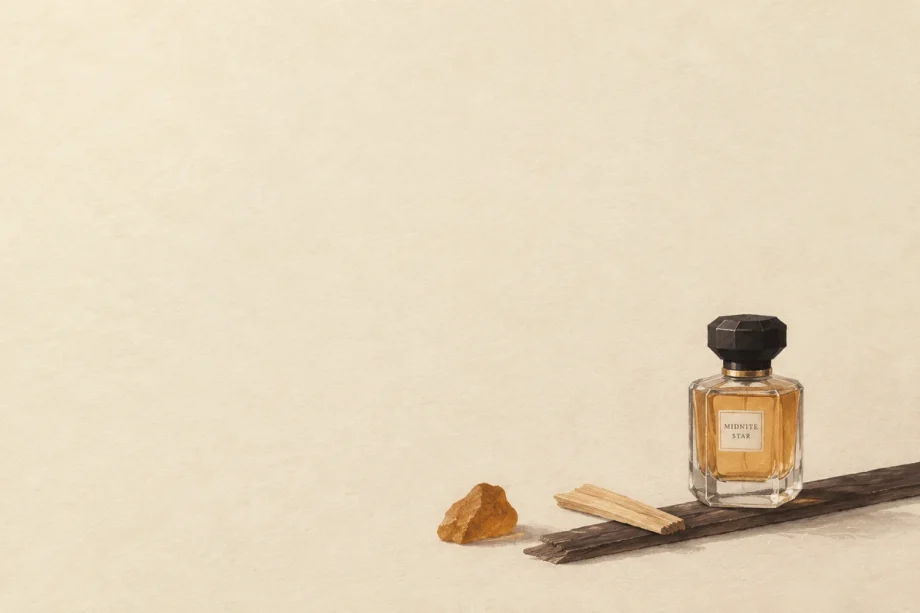
The question what do base notes do sounds like a technicality until you notice that the base is the part of a perfume you actually spend the day with. Base notes are the last layer of a composition and the longest one: they are the floor the fragrance stands on, and the reason a bright opening has something to land on at all.
The practical consequence is worth stating plainly. The opening is what you meet in the first minutes, but the base is what you live with — and it is what other people meet at four in the afternoon, long after the brightness has gone. If a bottle disappoints you at home after charming you in the shop, the base is usually where the disagreement lives.
None of which makes the opening unimportant. It is the part that gets a bottle bought, and it does that job well. The argument here is only about proportion: the layer that lasts longest deserves more of the decision than the layer that lasts least.
Three Jobs the Base Does
It holds the opening up. A bright opening with nothing underneath reads thin — pleasant for a moment, then weightless. The base gives it something to land on, which is why the same citrus can feel vivid in one bottle and flimsy in another. It is also what makes a composition feel finished rather than cut short: a fragrance that stops after its flowers reads like an unfinished sentence, however lovely the flowers were.
It sets the register. Warm, dry, earthy, powdery or clean is decided in this layer rather than at the top. The same peach can sit on a clean musk floor or on a vanilla one and read like two different fruits, and neither reading is a trick — the base is simply where the mood of the composition is fixed.
It becomes the part that stays. The base is what remains at the end of the day, and it is the part someone standing at arm’s length meets. Ask anyone who has been near you since morning what they noticed, and the answer is usually the base rather than the opening. The opening introduces you; the base is what is left in the room.
Four Base Registers
The range holds ten bottles — nine eau de parfums and one eau de toilette — and four of them show four different floors. They are not ranked; each is a different answer to the same question about what should sit underneath.
Resin warmth. 1957 closes on vanilla, honey, musk, cedar, Kashmir wood and iris root. That is the warm register at its most finished: sweet without being sugary, soft at the edges, with the iris giving it a powdery finish rather than a heavy one. The honey keeps the woods from turning dry, and the musk holds the whole floor close to the skin. Amber belongs in this family too — amber, the warm register’s own note is the page for the material that names it.
Earthy depth. Black Aya closes on musk, vanilla and patchouli, which is a very different floor: the vanilla softens the patchouli without hiding it, and the result reads grounded rather than sweet. Where the first register is warm and round, this one is darker and more textured — the base you notice as much as smell. The note itself has its own guide — patchouli, the earthy one — so this page only needs to place it in the base.
Dry wood. Midnight Star closes on cedar, musk and sandalwood. This is the driest of the four: no honey, no vanilla, nothing sweet to round the edges. Cedar brings the angular, slightly austere side and sandalwood the rounder one, with musk holding them together. The cedar and sandalwood pages are worth reading on their own account; both are named here only as the materials that make this floor what it is.
Clean musk. Pink Encounter closes on white musk and vanilla cedar, which is the light end of the base spectrum. White musk reads close and faintly powdery, and the vanilla cedar gives it a soft edge without turning it sweet. It is proof that a base does not have to be heavy to do its job: the floor here is soft, close and clean rather than deep.
The Same Opening, Two Different Bottles
How the layers work is the mechanic itself, and it belongs to that page rather than this one. What matters here is what the mechanic produces.
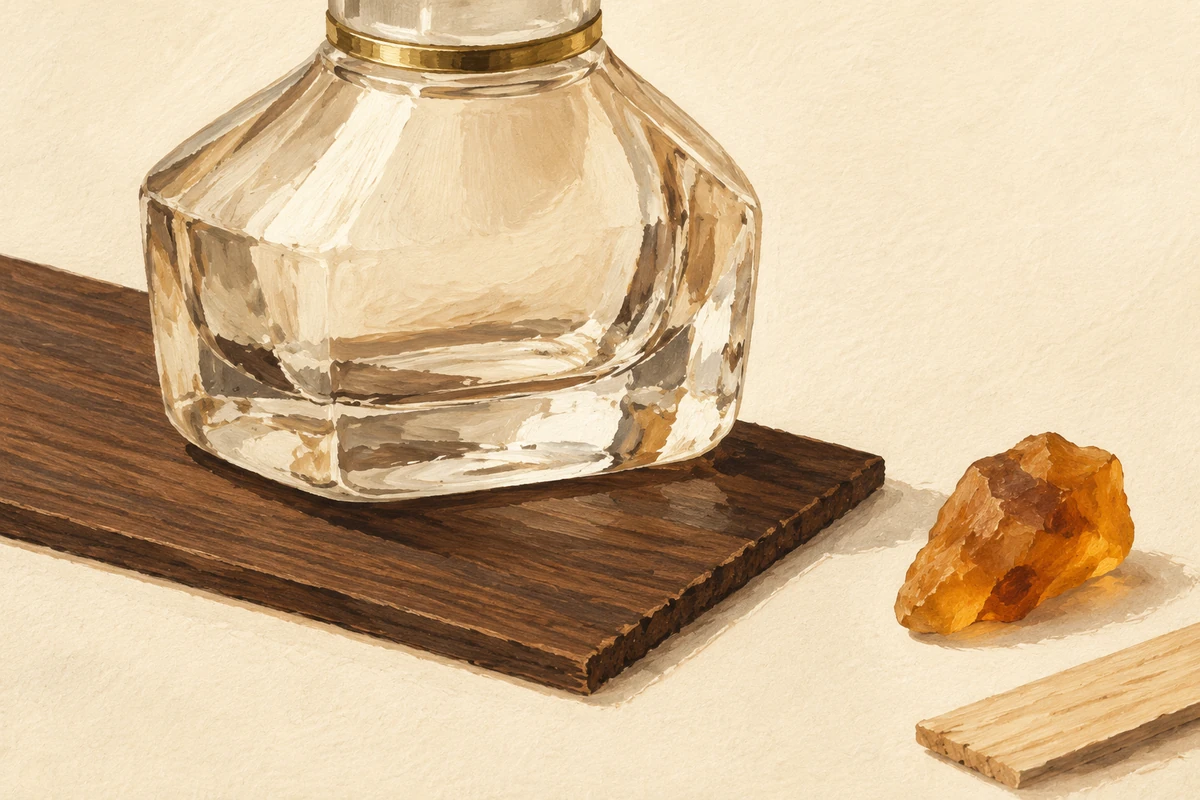
Midnight Star opens on grapefruit, lemon and mint — bright, cool, immediate — and lands on cedar, musk and sandalwood. 1957 opens on pink pepper, coriander, bergamot, aldehyde and musk — spiced, lifted, slightly soapy — and lands on vanilla, honey, musk, cedar, Kashmir wood and iris root.
Both openings are bright. Only one of them stays dry. The difference is not in the first ten minutes, which are the part most people compare; it is in the last row of the list, which is the part that decides whether you will still want the bottle next week.
That is also why comparing two bottles by their first spray is unreliable. You are comparing the part they are most likely to share, and learning the least about how they will differ. And it is why one bottle can feel like two different purchases depending on where you test it: the shop gives you the opening, your own room gives you the base.
Why the Disappointment Happens at Home
Shopping happens in the first minutes, in a shop, with the opening still in the air. Wearing happens over hours, in your own room, long after the shop has been left behind.
That gap is where most disappointment is manufactured. The base is the part of the purchase nobody tested, because testing it properly takes the one thing a shop cannot give you: time. A shop test also happens in a shared space, where the opening is competing with other smells and other people; at home the base has the room to itself, and it is the part that has to hold up.
The result is a familiar pattern: a bottle can be chosen entirely on its opening and then judged entirely on its base. That is why so many people own fragrances they admire and never reach for.
None of this requires a theory about skin. It is simply a mismatch between what was tested and what gets worn.
Reverse the Shopping Order
The fix is to read the note list backwards.
Start with the last row. Decide whether you want warm, earthy, dry or clean — the four registers above are a working set. That decision is the one you will live with.
Then read the opening. It tells you what the first impression will be, and first impressions matter, but they are ten-minute impressions rather than daily ones.
Weigh the two honestly. If you love an opening and dislike the base, you probably will not wear the bottle, however good it smelled on the strip. The reverse — loving the base and merely tolerating the opening — is far more common and far more wearable. The opening only has to be pleasant enough to get you to the base; the base has to be something you want to spend a day in.
It also makes the shop conversation easier. Asking what the last row is tells you more than asking what the first one is, and it gives the answer a shape you can compare across bottles.
If you want to browse by the floor rather than by the opening, the woody shelf gathers the dry end, and the darker shelf gathers the resinous and earthy ones.
Who Should Read the Base First
Three situations make the last row the most useful line on the page.
If your perfumes seem to disappear by lunchtime, the base is where the difference between bottles actually shows up — and reading it first tells you what you will have left. It will not make a light base heavier, but it will tell you whether you bought a floor or only an opening.
If you have bought a bottle you loved in a shop and then stopped wearing it, the base is the usual reason, and the note list will often say so before you spend anything.
And if you are choosing a bottle for ordinary days rather than for occasions, the base matters more than the opening, because ordinary days are mostly the hours after the first ten minutes. A daily bottle is mostly base, which is why the least dramatic line on the list is often the most useful one.
None of that is a claim about taste. It is a description of which part of a composition does the long work.
What Do Base Notes Do: Common Questions
What do base notes do?
They are the last and longest layer of a composition. They give the opening something to land on, they set whether the fragrance reads warm, dry, earthy or clean, and they are the part still present at the end of the day. They also explain the shape of a fragrance — why one ends soft and another ends dry.
Which base notes last longest?
The heavier registers — resins, patchouli and woods — sit closer and stay longer in the wearing. That is a description of how those floors behave rather than a ranking of quality, and the difference is mostly about how close they sit rather than about strength.
Are base notes always heavy?
No. Clean musk is a base, and it is one of the lightest things in a composition. Weight and depth are separate properties, and a base can be soft, close and quiet while still doing all three jobs.
How do I read a base?
Read the last row of the note list, then check the part still on your wrist after work. Those two readings usually agree, and when they do, you have found the register you actually like.
Read the last row first, and the rest of the list becomes easier to judge.