
What does unisex perfume mean in practice? Far less than most people assume — it is a filing and marketing decision, not a description of what is inside the bottle. A unisex tag says the shop is declining to make a call about who should wear a fragrance, and that is all it says. Whatever is in the bottle is whatever is in the bottle, labelled or not.
This site is an unusually good place to see that clearly, because its own shelves can be counted. Ten fragrances, five of them carrying the unisex tag — and every single one of those five is also filed under men’s or women’s. There is not one bottle anywhere in the range filed under unisex alone, and there is not one filed under men alone. Once you see that pattern, the word stops being mysterious and starts being what it actually is: a second tag, never a shelf.
What the Tag Is, and What It Is Not
Here is the finding, stated plainly. Five bottles carry the unisex tag: Midnight Star, Napoleon Eau and 1957, each of which is also filed under men’s; and Pink Encounter and Enchanted Fox, each of which is also filed under women’s. Meanwhile five bottles are filed under women only, and none — none — under men alone. So in this shop, unisex always rides alongside another category. It is an extra label added to a bottle that already has a home, not a section of its own that a bottle graduates into.
Why does that matter for a shopper? Because it settles the question the tag is usually asked to answer. The same bottle is the same liquid whichever shelf it sits on. Moving a fragrance from the women’s shelf to the unisex shelf changes its address, not its contents — and the moment you internalise that, the tag becomes a piece of store furniture rather than a verdict about the perfume. If you want to see how the shop groups these bottles in practice, browse the unisex selection and the men’s selection side by side; you will find the same names recurring, filed differently.
It is also worth noticing what the absence of a men-only shelf means. Ten bottles, and not one of them is parked in a men’s section by itself — the men’s tag, where it exists, always arrives attached to a unisex label as well. If gender filing were really about the contents of bottles, you would expect the categories to be symmetrical: a men’s shelf, a women’s shelf, and unisex drifting somewhere between. What the shop actually shows is a women-only shelf, a men-and-unisex overlap, and no men-only territory at all — which is argument enough that the whole system is about retail convention, not chemistry.
Why the Word Exists at All
If the tag describes nothing about the liquid, why does it exist? Because of a habit in how people talk about notes. In conversation — reviews, forums, gift guides — certain ingredients get gendered: flowers and vanilla get called feminine, woods and leather get called masculine. The materials themselves do not come with such labels; they simply sit in bottles and do what they do. A unisex tag is the shop choosing not to repeat the habit, nothing more. It says: we are not going to sort this for you by gender, because the sorting was never really about the scent in the first place.
That is worth saying carefully, because it is easy to overcorrect in either direction. The note-versus-gender habit is real and worth naming; the fix is not a new set of rules about who may wear what. It is simply this: the tags a shop applies, and the associations people carry, are descriptions of a conversation — not properties of a fragrance. Keeping those two things apart is most of what this article is for.
And it is worth appreciating why the shop can afford to decline the habit: because nothing in a bottle requires the sorting. A citrus opening behaves the same whoever sprays it; a sandalwood base dries down exactly as slowly on one wrist as another. The fragrance industry invented gendered shelving for its own convenience — recommending, bundling, gifting — and the shelving then took on a life of its own in how people talk. The unisex tag is not an innovation against that history; it is just one shop choosing, one label at a time, not to participate in the more confident parts of it. If the notes themselves could file themselves, this article would be unnecessary.
What the Tag Cannot Tell You
A unisex label is silent about nearly everything a buyer actually cares about. It says nothing about how strong a fragrance is, how far it projects, how sweet it reads, or how it will behave on a particular person. Those are decided by the composition and by perception — the same bottle genuinely can be described differently by two people wearing it side by side, which is why reviews of identical perfume often sound like reviews of different products. The site covers that phenomenon in its own right; if the question of how one fragrance reads on two different people interests you, why the same fragrance reads differently on two people is the place to continue. What matters here is only this: none of that information lives in the gender tag, so no tag can answer any of it.
A quick test makes the gap concrete. Take any bottle in this range and ask what the tag on its shelf tells you about the base row inside — you will find that it tells you nothing. The cedar, the vanilla, the iris root, the nougat: none of them consult the shelf before deciding how to smell. The tag is a sentence about the shop; the note list is a sentence about the fragrance. Buyers who learn to read the second sentence have stopped needing the first to make decisions.

How to Shop When You Ignore the Tags
The method that replaces the tags is the same method that works everywhere else in fragrance: read the base of the note list first. That is the part of the composition you will live with all day, and it is the honest predictor of what a fragrance will be like to wear — which is also why how to read a note list is worth ten minutes of anyone’s time before a purchase. The second check is character: does the scent sit close and quiet, or loud and expansive? Base and character together tell you more about whether a bottle suits you than any shelf ever will.
One honest caveat, because this article is not trying to abolish the labels: as a filter, they remain useful. If you are browsing a large catalogue and want to narrow it, using tags to sort the shelf is a perfectly practical shortcut — it is how stores are built. The mistake is only in treating a sorting habit as a rule about who is allowed to wear what. Use the tags to find bottles; use the base to choose between them. For the wider map of how fragrances get grouped by scent rather than by shopper, how the fragrance families differ picks up where this leaves off.
One more habit worth building, and then the method is complete: when a note list wins you over, note what it was that won you — a dry cedar base, a honeyed musk, a green opening — and file the bottle in your own head by that description rather than by its shelf. Two purchases in, your personal categories will be more accurate than any store’s, because they are built from the only data that reliably predicts your taste: what you actually reached for the second time.
Four Readings from the Unisex-Tagged Bottles
1957 — the Tidy Everyday
1957 opens on pink pepper, coriander, bergamot, aldehyde and musk, moves through orange blossom and jasmine at the heart, and settles onto a base of vanilla, honey, musk, cedar, Kashmir wood and iris root. It is the clean, composed everyday of the four: a musky floral with a soft, faintly powdery finish that neither shouts nor disappears. If you took the tags away entirely, this is the one most people would arrive at by description alone — and the composition is on 1957.
Midnight Star — the Crisp, Formal One
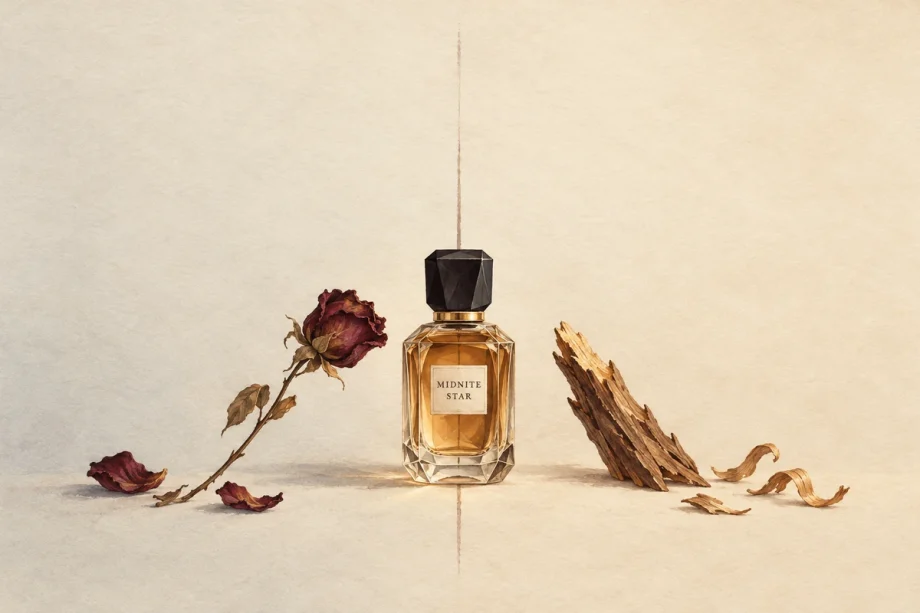
Midnight Star answers citrus and mint at the top, ginger, nutmeg and jasmine in the middle, and cedar, musk and sandalwood at the base — a crisp, dry composition that reads a little more dressed-up than the others. It is the bottle to pick when the occasion has a shape: evenings, meetings, anything that benefits from a scent with edges. See the full composition on Midnight Star.
Pink Encounter — the Lightest
Pink Encounter opens on grape and blackcurrant over jasmine and Rose Taif Flower, with a base of white musk and vanilla cedar — clearly the lightest of the four, and the most forgiving. It is the unisex tag’s quiet proof that the word runs in both directions here: this bottle is filed under unisex and women, not under men, and yet nothing about it would stop anyone from wearing it. The reasoning is in the liquid, not the shelf. Pink Encounter is the mildest reading of the group.
Enchanted Fox — the Soft and Sweet One
Enchanted Fox puts rose and orange over musk and woody notes, and lands on nougat — the softest, sweet-leaning member of the four. Where Midnight Star has edges, this one has edges dissolved; it is the reading to choose when you want the gentler, warmer end of the shelf without crossing into dessert territory entirely. The composition is on Enchanted Fox.
One further note in passing: Napoleon Eau, the third men-and-unisex bottle, is the boldest composition in the range — worth knowing about, though the four above cover the span from crisp to soft on their own.
The Reverse Question
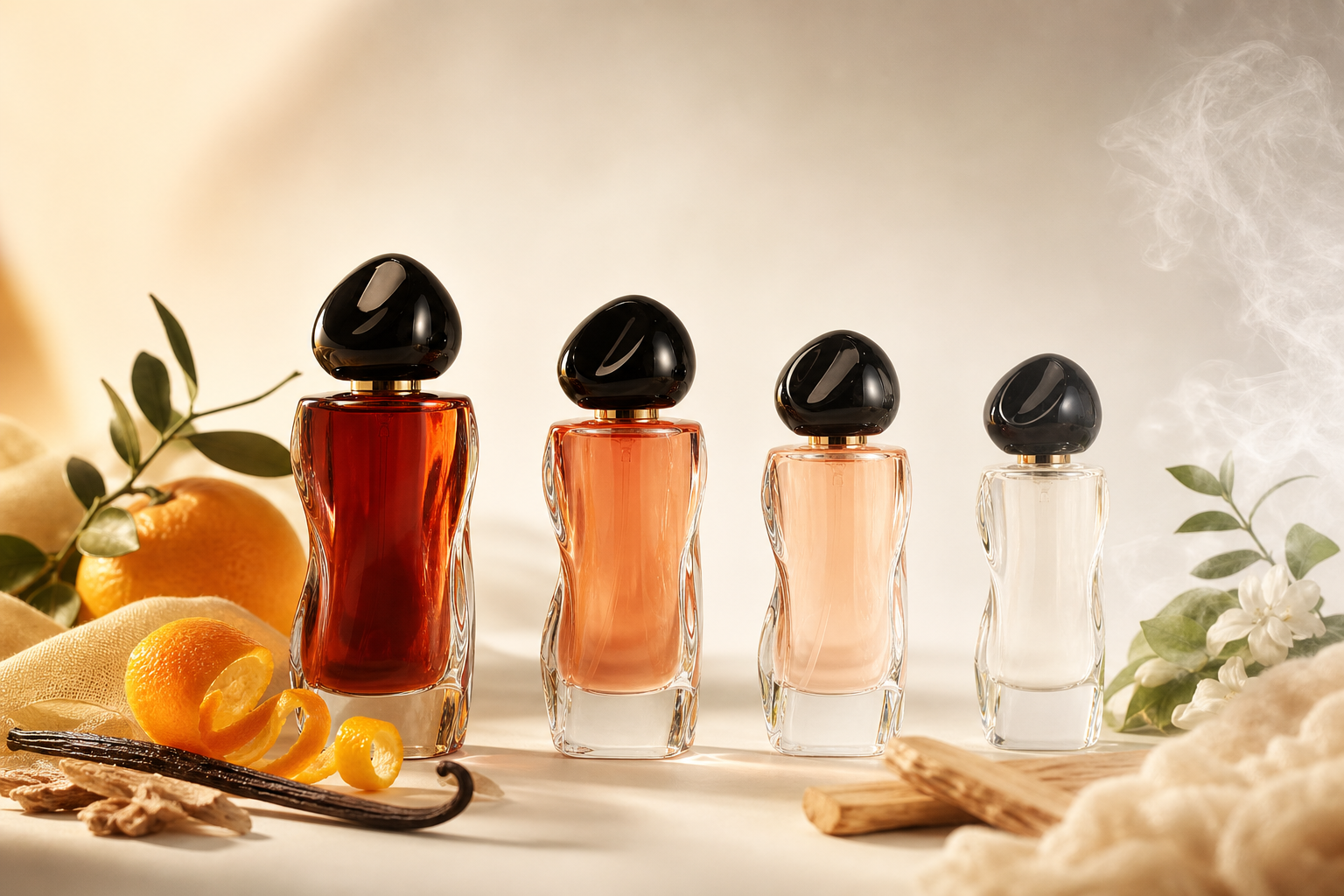
Which brings us to the question this article is quietly built around — the one people usually arrive with, in these exact words: can men wear women’s perfume, or women wear a bottle from the men’s shelf? Nothing about the liquid changes — the base is the base, the bottle is the bottle — and the practical check is the same one used everywhere above: whether the base is something you would enjoy living with all day. If it is, the filing is irrelevant; if it is not, no tag will save the purchase.
What Does Unisex Perfume Mean: Common Questions
What does unisex perfume mean?
It means the shop is not making a gendered call about a fragrance — a filing and marketing decision rather than a description of the contents. Here, every unisex bottle is also filed under men’s or women’s, which shows exactly how much weight the word carries on its own.
Is unisex perfume different from men’s or women’s perfume?
Not in any way the label itself explains. The same fragrance is the same fragrance regardless of shelf; in this range the unisex bottles carry a second tag rather than standing apart. If unisex perfume is different in any sense, it is different in how it is filed — not in what it is.
Why are some notes called feminine or masculine?
Because people, over time, have associated certain notes with certain wearers — flowers and vanilla with one side, woods and leather with the other — and that habit lives in conversation rather than in the materials. The notes themselves carry no such label; what travels with them is the way people talk about them.
Can a man wear a fragrance filed under women’s?
There is no physical reason the filing would prevent it — the liquid does not check who is holding the bottle. The practical test is identical to every other in this guide: read the base, decide whether you want to live with it all day, and let that answer be the one that counts. A gender neutral fragrance, in the end, is simply one whose note list you have actually read.