
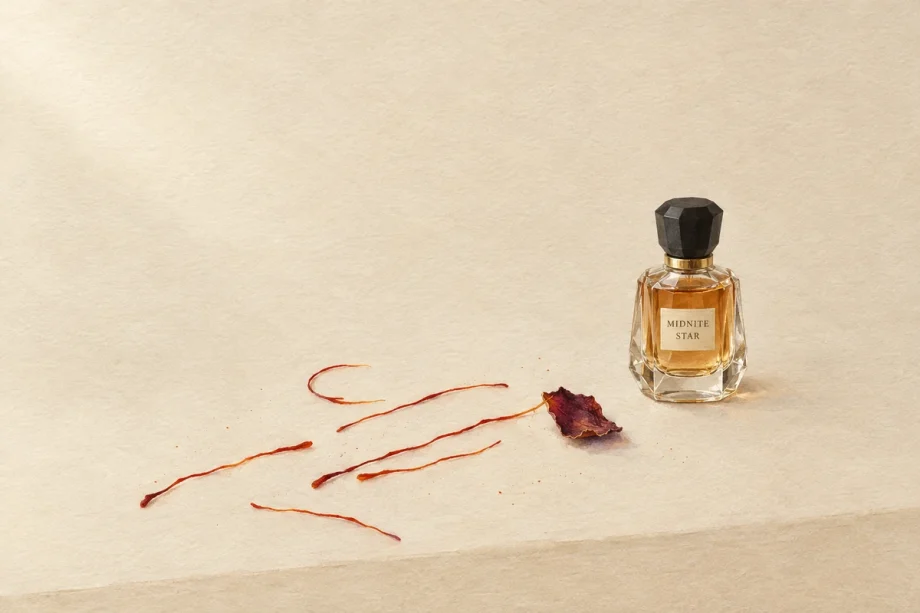
What does saffron smell like in perfume? The short answer is warm, dry and faintly leathery — closer to the texture of fabric than to the spice the name suggests. It is bright at the same time, a little dusty, and it does not behave at all like the spices most people know. Put in one line: saffron is how a composition gets a suede surface without any leather being listed.
That sentence is the whole page in miniature, but it needs unpacking. What follows explains why suede is the right word for it, follows the leathery thread through the one bottle here that contains saffron, contrasts that dryness with three other registers in the range, and says who tends to like the result. It is also why the note is easier to recognise in a composition than to describe in isolation: it is a surface effect, and surfaces need something to sit on. The distinction matters, too, because it sets expectations: come to saffron looking for food and the note reads as a mistake, while coming to it looking for fabric makes it click immediately.
Why Suede Is the Right Word
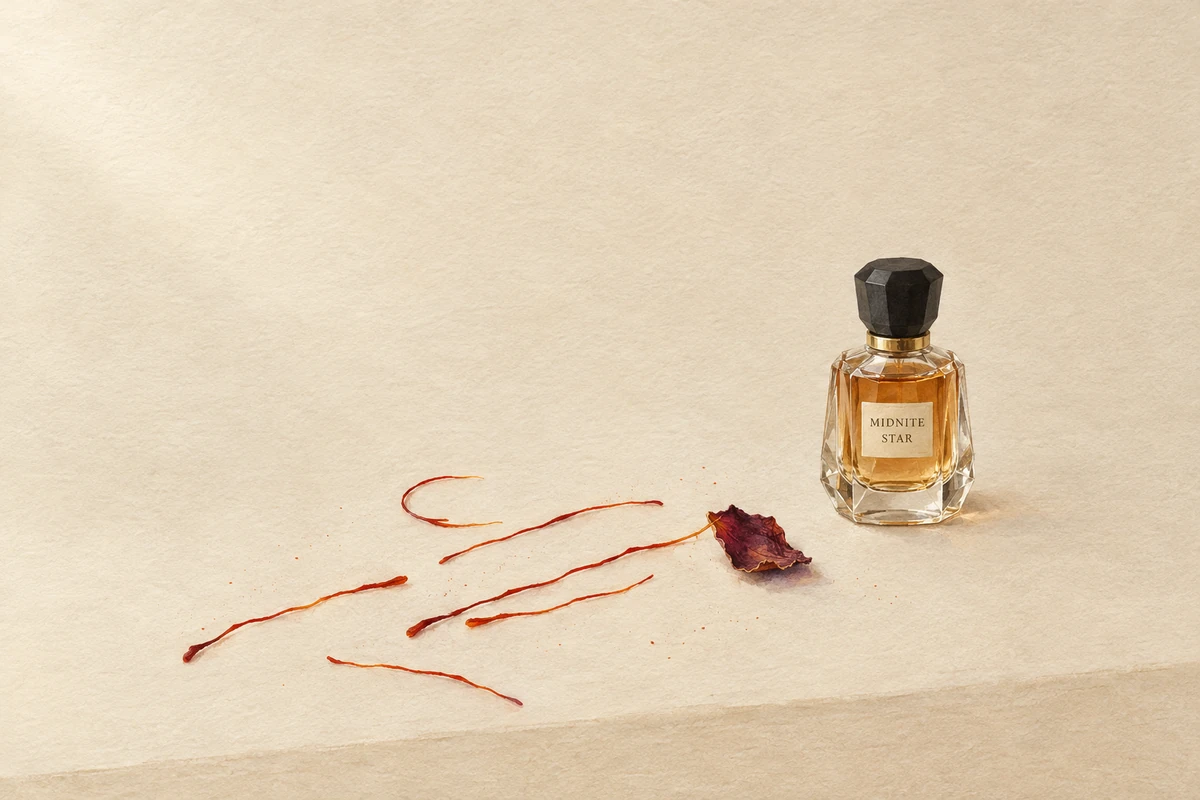
Suede is a texture before it is a smell: soft, dry, slightly matte, with no sweetness and no shine. Saffron lands in exactly that register. Where fruit reads juicy and resin reads warm and enveloping, saffron reads dry and slightly powdery — a texture rather than a scent, something with a nap to it. In a note list it is often paired with words like dry, dusty, matte or papery, and all of those describe a finish rather than a source.
This is why the saffron perfume note is so often described with fabric words. It has brightness, but the brightness is dusty rather than juicy; it has warmth, but the warmth is dry rather than sweet. Nothing about it glows. If you imagine running a hand over a suede panel — soft, matte, faintly rough in one direction — you have the shape of the sensation, and the leathery perfume note people describe is that sensation rather than any actual leather.
The comparison also explains the word’s limits. Suede, unlike polished leather, is a quiet material: it absorbs light instead of reflecting it. Saffron behaves the same way. It never glares, never shines, and never turns into a statement — which is exactly why it works so well underneath other notes.
The Leathery Thread in This Range
Saffron appears in exactly one bottle here: Lily of the Valley No. 7, the range’s only eau de toilette. It sits in the middle of the composition, alongside lily of the valley and rose, over a base that lists suede, musk, sandalwood, frankincense and amber.
That structure is the point. The leathery register begins in the middle and finishes in the base — one continuous thread running from the heart down to the dry-down, rather than a single accent that flashes and leaves. And because the opening above it is herbal and cool, with thyme and tea, the suede reads soft rather than heavy: there is nothing rich or syrupy above it to make the fabric feel weighted.
The rest of that base — musk, sandalwood, frankincense and amber — supports the fabric rather than competing with it, which is why the dry-down never turns sweet. It stays matte to the end, which is rarer than it sounds.
One word on the format, since it is easy to miss: this is the only eau de toilette in the range, the lighter of the two formats the shop uses. Nothing about the saffron changes with it — the fabric simply sits closer to you, which suits a texture whose whole character is quiet.
Worth pointing out, too, which word does the work. Saffron supplies the texture; suede names it. Saffron and suede sit one layer apart in the note list, and together they read as one surface: warm, dry, matte, quietly present.
Dry Versus Warm: Three Other Registers
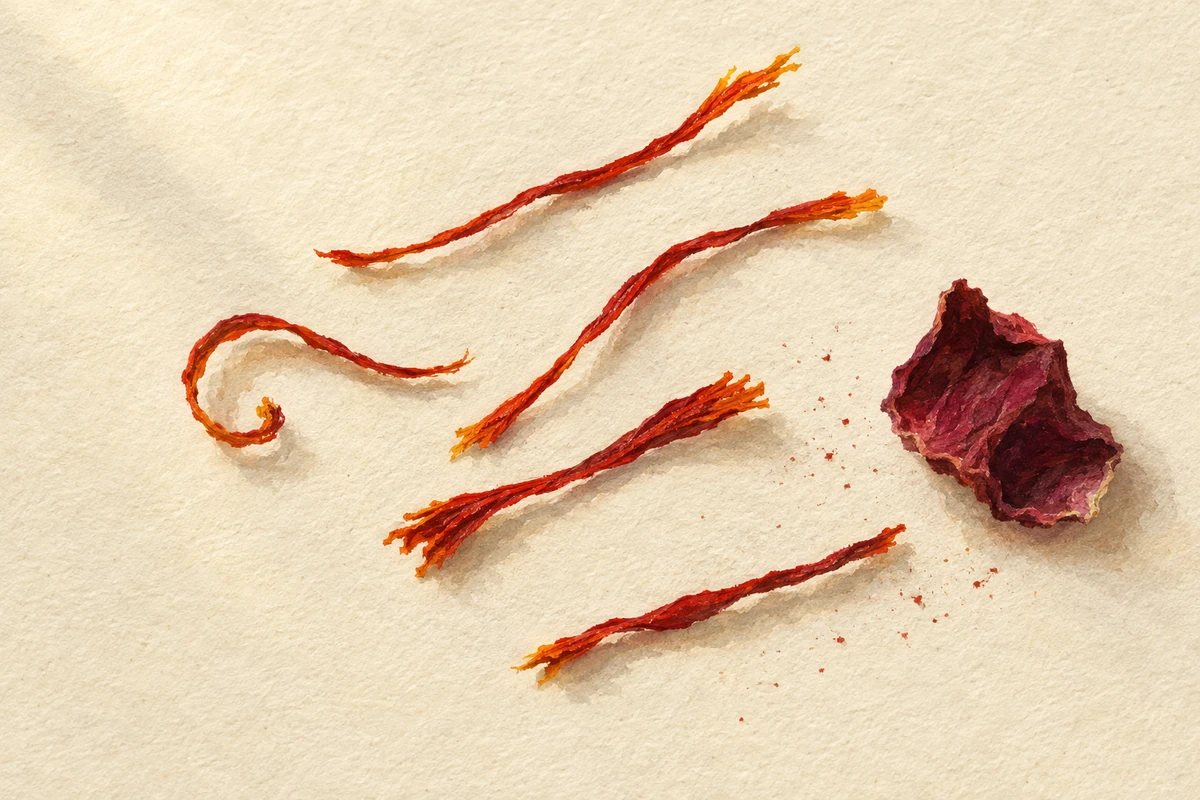
Dryness is easier to understand against its neighbours, and this range happens to supply three distinct ones. The dry spicy perfume label is easiest to grasp the same way — by comparison, not by definition.
The first contrast is warmth. The warm resinous pole is amber — resinous, enveloping, round. It shares a shelf with saffron and reads nothing like it: where amber wraps, saffron sits flat and matte beside you. Resin fills a room’s air; a dry surface waits to be touched. That makes the two a useful pair to smell side by side, because they are the same shelf’s opposite answers to the question of what warmth should do.
The second contrast is powder. 1957 lands on vanilla, honey, musk, cedar, Kashmir wood and iris root, and that base reads powdery and soft — dry in its own way, but with no leathery edge at all. Same absence of juice, entirely different surface: powder is a cloud, suede is a panel.
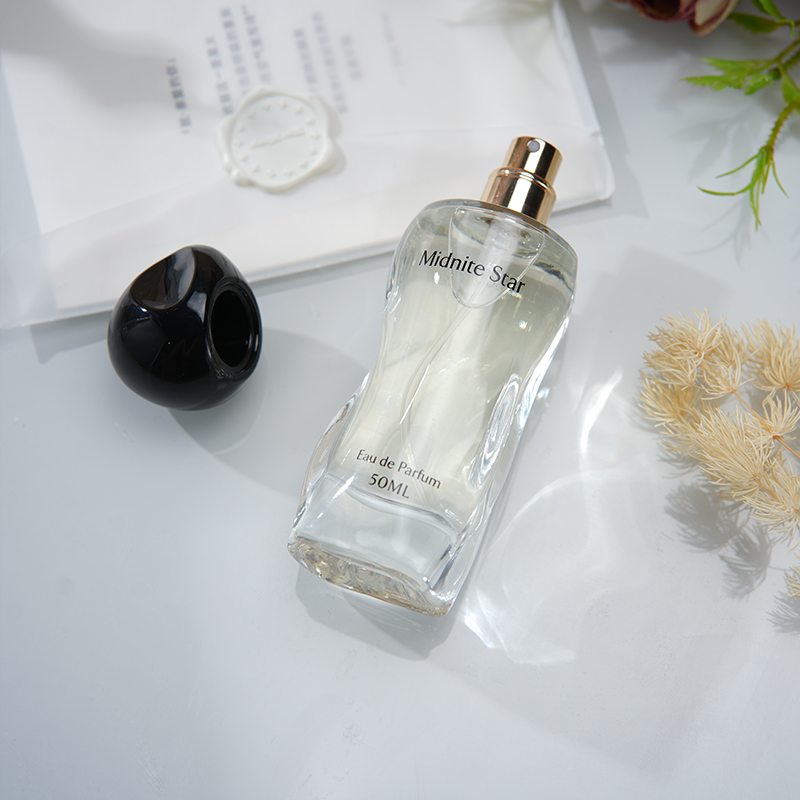
The third is drier still. Napoleon Eau carries birch in its base, which is the smoky, tarry end of the dry register — where saffron is soft matte, birch is dark and ashen. Three bottles, three kinds of dry: warm-dry, powdery-dry, smoky-dry. All three belong to the same direction of smell, and none of them is a synonym for the others — which is the takeaway worth carrying: dry is a direction, not a single scent.
How It Behaves in Wear
In practice, saffron arrives after the opening rather than in the first minute. It stays close rather than travelling — this is a register that keeps to itself, which makes it a poor choice for anyone hoping a fragrance will announce them from across a room and a very good one for anyone who prefers to be met up close.
Its other habit is structural: it holds a composition together instead of standing out from it. That is why the dry register so often reads as composed and deliberate, and why a scent built this way tends to feel finished rather than busy. Judged that way, the register is one of the most reliable in the whole catalogue: it does not surprise you at hour three, and it does not collapse.
Cold air suits it. In cold weather the dry register reads warmer and more comfortable — the same bottle that feels austere in heat feels settled in November — which is why why cold air suits a dry register is the seasonal companion to this page. Dryness, in cold air, behaves like warmth. It is also why the register reads formal to some people and austere to others: there is no sweetness to soften it and no projection to carry it away from you.
Who Tends to Like It
As a matter of preference, not identity: readers who find sweet and fruity compositions exhausting; readers who like the smell of fabric, paper, suede or dry wood; readers who want something quiet that still has an edge. If you have ever preferred the smell of a coat to the smell of a dessert, this register was built for you.
It is also worth saying plainly that saffron rarely stands alone. It is almost always a middle note in company — rose, incense, woods — and that is not a limitation but the point: saffron is a texture for other notes to sit on. A composition that lists it is telling you the surface it will have, and nothing more specific than that. And if the note list says suede while the base is built on sugar, expect the fabric to be buried: the base decides how much of the matte surface you actually get to smell.
If you want to place it among the wider catalogue, how the shop files its bottles explains the family system, and the bottle above is filed on the oriental and ambery shelf as well as on the romantic shelf. Those are the shop’s own filings, not claims about who should wear what. And if you read note lists to predict a bottle’s character, this is one of the cleanest examples on the site: one word in the middle tells you the surface, and one word in the base confirms it.
How to Try It Without Overcommitting
Keep it small. One or two passes, worn for a full day, and judged from the second hour rather than the first ten minutes — the dry register needs time to settle before it shows its actual shape. Ten bottles make a range, but a single day makes a verdict, and the dry register is one of the few things in fragrance that rewards patience more than enthusiasm. If after a full day it still reads flat or dusty to you, that is a reliable answer too — the register either clicks or it does not, and one day is enough to know.
What Does Saffron Smell Like in Perfume: Common Questions
What does saffron smell like in perfume?
Warm, dry and faintly leathery, with a dusty brightness. It reads like a texture — soft, matte, slightly rough — which is why fabric words fit it better than any description of what it smells of. Most people meet it first as a texture they cannot place, and place it only once they compare it with something warm.
Is saffron spicy or leathery?
Both descriptions are used, and neither is quite complete. It has a dry spice-like brightness, but its dominant note is a leathery, suede-like surface. A leathery note without the brightness would read heavy; a spice without the fabric would read sharp. Saffron sits where the two overlap, which is why it needs both words. If you had to choose one for a note list, leathery is the more accurate of the two.
Does saffron perfume smell like the spice used in cooking?
No — in a composition it reads dry and fabric-like rather than culinary. The resemblance is in the name and nowhere else.
What does saffron pair with?
Rose and incense are the classic partners, and this range makes the rose pairing in a single bottle. Warm woods work too, and so does anything that needs a matte surface under it — saffron behaves well in company, and rarely asks to lead. If you want a single rule: pair it with something that needs a matte finish, and it will disappear into the job rather than announce itself.